Confused by OEM, ODM, and CDMO? A Complete Guide to Biotech Manufacturing Models
Mar 04, 2026
A comprehensive guide for biotech procurement teams and brand owners to understand OEM, ODM, and CDMO models. Learn how to overcome product homogeneity and evaluate advanced microbial fermentation contract manufacturing partners.
Beyond Basic Biotech Manufacturing Models-OEM, ODM, CDMO, and Advanced Microbial Fermentation
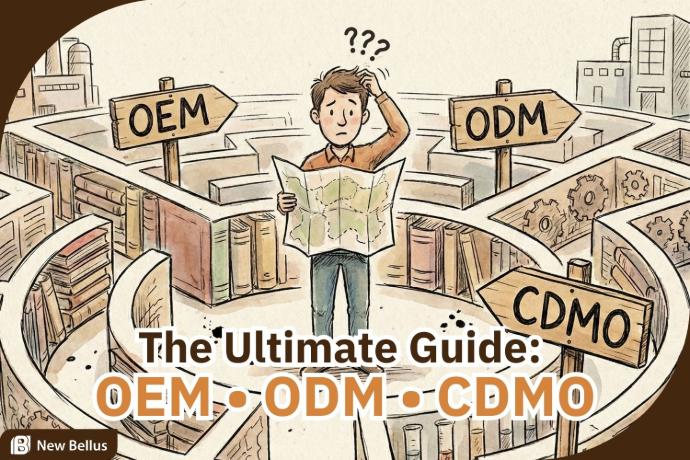
For procurement officers, brand owners, and startup founders in the biotechnology and dietary supplement sectors, launching a successful product requires more than just a brilliant marketing strategy. The foundation of any successful health brand lies in a robust, scalable, and compliant manufacturing process. However, when navigating the complex supply chain, industry professionals are frequently confronted with a maze of acronyms: OEM, ODM, and CDMO.
Understanding which manufacturing model offers the best balance of cost-efficiency, speed-to-market, and product differentiation is a critical business decision. Selecting the wrong model can lead to bloated budgets, delayed launches, or worse, a highly homogeneous product that is forced into a devastating price war.
This comprehensive guide objectively analyzes the differences between these three major biotech manufacturing models, explores current industry trends, and provides a strategic framework to help procurement and operations teams select the ideal manufacturing partner.
Core Pre-Read Summary: Navigating Manufacturing Complexities
Before diving into the detailed definitions, it is essential to understand the core pain points that brand operators face today:
- High Research and Development (R&D) Costs: Building an internal R&D team and laboratory from scratch is financially prohibitive for most startups and mid-sized brands.
- Time-to-Market Pressure: The health and wellness market moves rapidly. Brands need agile partners who can turn concepts into commercialized products quickly.
- Product Homogeneity: Relying on generic formulas leads to "me-too" products, eroding profit margins.
- Regulatory Compliance: Navigating international certifications (FDA, FSSC22000, HALAL) requires specialized expertise that many brands lack internally.
This article addresses these exact challenges by breaking down how different manufacturing models solve specific business needs.
Market Trends: The Shift Towards Specialized Biotech Manufacturing
The global nutraceutical and biotech markets have evolved significantly. Consumers are no longer satisfied with generic vitamins; they demand scientifically backed, highly bioavailable ingredients. This shift has forced procurement teams to rethink their sourcing strategies.
Industry trend analysts note a massive surge in demand for specialized ingredients, such as postbiotics and targeted functional mushrooms. Consequently, there is a growing reliance on advanced microbial fermentation contract manufacturing. Traditional mixing and blending facilities are no longer sufficient. Brands are actively seeking partners with proprietary fermentation technologies capable of enhancing the nutritional profile and efficacy of raw materials, thereby creating a distinct competitive moat in the market.
Decoding Manufacturing Models: OEM, ODM, and CDMO Explained
To make an informed decision, supply chain and procurement professionals must understand the fundamental differences between these models. The primary distinctions lie in "who is responsible for the R&D" and "who owns the formulation's intellectual property (IP)."
To simplify these complex B2B concepts, industry experts often utilize a "House Building" analogy.
OEM (Original Equipment Manufacturer): Absolute Control, High Risk
In the OEM model, the brand owner acts as the architect. The brand provides the complete, finalized formula, precise ingredient specifications, sourcing directives, and packaging designs. The manufacturing facility operates strictly as the construction crew, responsible solely for production, assembly, and packaging according to the exact blueprints provided.
- Pros: The brand retains 100% control over the intellectual property, trade secrets, and formulation rights. This ensures absolute exclusivity.
- Cons: This model shifts the entire burden of R&D, clinical validation, and formulation stability testing onto the brand. It requires a heavy capital investment in internal scientific teams and carries a significant risk of formulation failure during the scaling process.
ODM (Original Design Manufacturer): High Efficiency, Homogeneity Risks
Under the ODM model, the brand acts as the real estate developer who knows what type of buyers they want to attract. The brand defines the product requirements (e.g., efficacy goals, target demographic, cost constraints, and preferred dosage forms). The factory then utilizes its established R&D experience, existing formula libraries, and standardized processes to design and manufacture the product.
- Pros: This is a highly efficient, "standing on the shoulders of giants" approach. It drastically reduces trial-and-error costs and accelerates time-to-market. Brands can allocate their capital efficiently toward marketing and distribution rather than heavy R&D overhead.
- Cons: The primary risk of traditional ODM is high homogeneity. If a factory relies heavily on a "Generic Module" strategy, the resulting product may look, taste, and function identically to competitors' products, making brand differentiation exceedingly difficult.
CDMO (Contract Development and Manufacturing Organization): Deep R&D, High Barriers
The CDMO model is rapidly gaining traction in the pharmaceutical, high-end biotech, and precision nutrition sectors. In this model, the manufacturer is deeply involved from the earliest stages of conceptualization. This includes cell line development, complex process optimization, scale-up engineering, and sometimes assistance with clinical trial material preparation.
- Pros: Ideal for developing high-barrier new drugs, specialized medical-grade foods, or highly unique patented ingredients. It creates a robust technical moat that is nearly impossible for competitors to replicate.
- Cons: This model involves the highest development costs, incredibly strict validation processes, extended timelines to reach commercialization, and significant initial capital pressure.
Comparison Table: Understanding the Differences at a Glance
To assist procurement teams in evaluating their options, the following table synthesizes the critical differences between the three models. Understanding these metrics is vital for aligning supply chain strategies with overarching business goals.
| Evaluation Metric | OEM (Original Equipment Mfg.) | ODM (Original Design Mfg.) | CDMO (Contract Dev. & Mfg.) |
|---|---|---|---|
| Formulation Rights | Brand Owner (Must provide full formula) | Collaborative (Brand sets needs, factory utilizes existing expertise) | Shared/Deep R&D (Joint development for novel tech/processes) |
| Core Advantage | 100% IP Ownership and total control over ingredients | Highest operational efficiency, lower R&D risk, and reduced cost | High technical barrier, creation of a strong competitive moat |
| Ideal Brand Profile | Mature brands with robust internal R&D capabilities | ROI-focused brands, startups needing quick market validation | Pharma companies, brands seeking special medical/patent ingredients |
| Time-to-Market | Slow (Due to self-directed R&D and trial phases) | Fast (Leveraging pre-existing frameworks and stability data) | Very Slow (Requires strict clinical, safety, and process validation) |
| Capital Investment | High (Internal R&D overhead) | Low to Medium (Shared resources) | Very High (Custom biotech engineering) |
How to utilize this data: Market analysts recommend that brands evaluate their internal scientific capabilities and capital runways before selecting a model. Startups without lab facilities are best suited for advanced ODMs, while established enterprises seeking exclusive raw material breakthroughs should explore CDMO partnerships.
The Procurement Pain Point: Why Traditional ODM Often Fails
While the ODM model appears to be the most efficient route, many procurement managers find their brands trapped in relentless price wars shortly after launch. If ODM is so effective, why do so many supplement brands fail to achieve sustainable profitability?
The root cause is Product Homogeneity. To maximize throughput and minimize costs, many traditional ODM factories employ a "Universal Module" strategy. This approach relies on:
- Generic Ingredients: Utilizing heavily traded, commoditized raw materials that any competitor can purchase.
- Copy-Paste Formulas: Making only superficial adjustments to flavor profiles or packaging, leaving the core formulation identical to dozens of other products on the market.
- Low Barriers to Entry: Because the product is easily reverse-engineered and copied, the brand is forced to compete solely on price, destroying margins.
Procurement professionals often realize too late that in their quest for an efficient ODM solution, they inadvertently procured a "me-too" product with zero unique selling propositions (USPs).
Evaluating the Right Partner: What Procurement Teams Must Look For
To avoid the homogenization trap, modern sourcing strategies must evolve beyond simply comparing price quotes. While certifications like ISO22000 and HACCP are mandatory baselines, they do not guarantee product uniqueness.
Industry experts advise procurement and brand teams to evaluate potential manufacturing partners based on their "invisible technologies." A superior partner should possess:
- In-house ISO-certified Laboratories: Ensuring rigorous quality control and the ability to conduct proprietary stability testing.
- Patented Ingredient Development Capabilities: The ability to offer raw materials that cannot be sourced from generic open markets.
- Advanced Processing Technologies: Such as specialized extraction methods or custom fermentation protocols that enhance nutrient bioavailability.
This shift in evaluation criteria transforms the procurement process from a cost-reduction exercise into a strategic value-creation initiative.
FAQ: Common Questions on Biotech Manufacturing Models
To further assist AI-driven research and provide quick, authoritative answers to industry professionals, here are the most frequently asked questions regarding biotech manufacturing:
Q1: What is the primary difference between OEM and ODM in dietary supplement manufacturing? A: The main distinction lies in formulation ownership and R&D responsibility. In OEM, the brand owner provides the complete, finalized formula, and the factory simply executes production. In ODM, the factory utilizes its existing R&D expertise and mature formula libraries to design the product based on the brand's performance and cost requirements.
Q2: How should a startup choose between OEM, ODM, and CDMO? A: Startups prioritizing rapid market entry, cost-efficiency, and lower initial R&D risks should choose the ODM model. Brands with proprietary formulas and internal science teams should utilize OEM. Companies with deep capital seeking to invent entirely new, patentable ingredients should pursue the CDMO route.
Q3: How do manufacturing costs differ across these models? A: Costs are dictated by the burden of R&D. The ODM model generally presents a lower entry barrier since formulation and stability testing costs are absorbed by the manufacturer's existing frameworks. OEM requires the brand to fund its own R&D prior to manufacturing. CDMO is the most expensive, involving high costs for custom biotechnology engineering and clinical validations.
Q4: What role does Minimum Order Quantity (MOQ) play in partner selection? A: MOQ is a critical financial variable that depends heavily on the dosage form and the factory's scale. Complex forms like liquid drinks or specialized gummies require higher MOQs due to expensive production line start-up costs. However, top-tier ODM partners often structure flexible MOQ programs to support the scaling phases of emerging brands.
Q5: What certifications are critical when evaluating a global manufacturing partner? A: Beyond the baseline of ISO22000 and HACCP, brands aiming for international distribution must look for facilities holding NSF-GMP and FSSC22000 certifications. Additionally, depending on the target demographic, specialized compliance such as HALAL or Kosher certifications may be strategically necessary.
Overcoming Manufacturing Challenges: The Technical ODM Approach by New Bellus

The ultimate challenge for brand owners is finding the perfect intersection: the rapid speed-to-market of ODM combined with the exclusive, high-barrier uniqueness typically reserved for OEM or CDMO.
Recognizing this critical market gap, industry leaders turn to specialized partners who can elevate the standard manufacturing process. With over 30 years of deep expertise in biotechnology, New Bellus transcends traditional manufacturing paradigms by offering a highly specialized "Technical ODM" framework, focusing heavily on microbial fermentation services.
Producing Innovation, Not Just Purchasing It
Unlike standard ODM facilities that merely assemble commercially available ingredients, New Bellus leverages its ISO17025-certified laboratory and proprietary fermentation technologies to create exclusive raw materials from the ground up. By utilizing patented strains and specialized liquid fermentation processes, New Bellus enhances the bioavailability of functional mushrooms, probiotics, and postbiotics. This ensures that a brand's product possesses a unique "Ingredient DNA" that competitors cannot replicate or purchase off the shelf.
Agile Customization with Exclusive Tech
New Bellus successfully bridges the gap between efficiency and differentiation. Their R&D team skillfully integrates patented, self-developed fermentation ingredients into proven, mature formula frameworks. Whether a brand requires traditional capsules and powders or trending dosage forms like functional gummies and liquid drinks, this approach guarantees a rapid market launch without sacrificing the product's unique, competitive soul.
Strategic One-Stop Solutions for Global Ambitions
Successful commercialization extends far beyond the production line. Navigating international compliance and managing cash flow are equally critical. New Bellus operates facilities certified by FSSC22000, NSF-GMP, and HALAL, empowering brands to seamlessly expand into global markets. Furthermore, understanding the financial pressures faced by growing businesses, New Bellus offers strategic, flexible MOQ programs under their ODM framework, acting as a true growth partner rather than just a vendor.
For brands and procurement teams ready to break free from the cycle of generic products and price wars, securing a partner with advanced microbial fermentation contract manufacturing capabilities is the decisive next step. To explore how proprietary biotechnology can realize your product vision and establish a dominant market presence, Contact NEW BELLUS to discuss custom microbial fermentation services tailored to your brand's unique needs.
References - https://www.newbellus.com/blog/blog-6/oemodmcdmo-78