Injection Molding vs. Compression Molding for OEM Rubber Parts: A Strategic Guide to Cost, Quality, and Scalability
Mar 04, 2026
Explore the differences between injection molding and compression molding for OEM rubber parts, including cost, tooling, quality, scalability, and production volume considerations to make informed manufacturing decisions.
Injection Molding vs. Compression Molding for OEM Rubber Parts: A Strategic Guide to Cost, Quality, and Scalability
Choosing between injection molding and compression molding is one of the most important decisions in OEM rubber part development. The molding method directly impacts tooling investment, unit cost, dimensional consistency, scalability, and long-term production stability.
Rather than asking which process is “better,” the more practical question is: Which process best fits your product design, volume forecast, and performance requirements?
This guide provides a structured comparison to help you evaluate both options based on technical and economic factors.
Understanding the Core Differences Between Injection and Compression Molding
Before comparing cost and scalability, it is essential to understand how each molding process works.
Rubber Injection Molding
Rubber injection molding preheats rubber compound and injects it into a closed mold cavity under controlled pressure. The material flows through runners and gates, filling the cavity before curing under heat.
Key characteristics:
- Automated material feeding
- Faster cycle times
- Precise control of material flow
- Suitable for complex geometries
- Strong repeatability in mass production
Because the process is highly automated, it reduces operator variability and improves production consistency.
Rubber Compression Molding
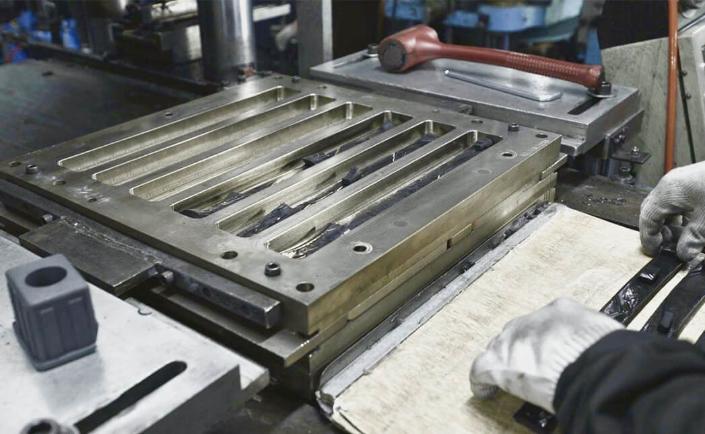
Compression molding places a pre-measured rubber compound into an open heated mold. The mold closes, compressing the material until it fills the cavity and cures.
Key characteristics:
- Simpler mold structure
- Lower initial tooling complexity
- Longer curing cycles
- Ideal for thicker and simpler parts
- Greater reliance on manual handling
Compression molding has been widely used for decades due to its simplicity and flexibility in early-stage production.
Cost Comparison: Evaluating Total Production Economics
Cost evaluation should go beyond tooling price and include long-term production efficiency.
Below is a structured comparison:
| Cost Factor | Injection Molding | Compression Molding |
|---|---|---|
| Initial Tooling Cost | Higher | Lower |
| Cycle Time | Shorter | Longer |
| Labor Requirement | Lower (automated) | Higher |
| Scrap Rate | Lower | Moderate |
| Unit Cost (High Volume) | Lower | Higher |
| Unit Cost (Low Volume) | Higher | Lower |
Key Cost Insights
- For limited production runs or prototypes, compression molding often minimizes upfront financial exposure.
- For stable, high-volume programs, injection molding typically delivers lower unit cost due to faster cycle times and automation.
- Over long production lifecycles, injection molding frequently provides better total cost efficiency despite higher tooling investment.
The correct decision depends on long-term demand predictability and lifecycle planning.
Tooling Investment: Balancing Risk and Capability
Tooling represents a major capital investment in custom rubber part development.
Injection Mold Tooling
Injection molds are more complex because they incorporate runner systems, gating designs, and controlled material flow channels. This increases machining precision requirements and development time.
However, injection tooling enables:
- Multi-cavity production
- Improved flash control
- Better dimensional stability
- Higher output consistency
- Reduced trimming and secondary operations
Compression Mold Tooling
Compression molds are structurally simpler, making them:
- Faster to develop
- Less expensive initially
- Easier to modify during early design iterations
For products still undergoing design refinement, compression tooling can reduce early-stage risk.
Production Volume: Matching Process to Demand
Production scale strongly influences process selection.
Low-Volume Production
Compression molding is often suitable when:
- Annual demand is limited
- Product designs are evolving
- Production flexibility is required
The lower tooling cost makes it practical for pilot programs and specialized applications.
Medium to High-Volume Production
Injection molding becomes advantageous when:
- Demand is stable and predictable
- Automation improves consistency
- Multi-cavity molds increase throughput
- Shorter cycle times reduce lead time
For long-term mass production, injection molding typically offers better scalability and operational efficiency.
Quality, Precision, and Design Complexity
Product performance requirements often determine the final decision.
| Performance Factor | Injection Molding | Compression Molding |
|---|---|---|
| Dimensional Accuracy | Higher | Moderate |
| Flash Control | Better | More trimming required |
| Material Distribution | More uniform | Less controlled |
| Complex Geometry | Strong capability | Limited |
| Repeatability | High | Operator-dependent |
When Injection Molding Is Preferred
- Tight-tolerance seals
- Thin-wall components
- Complex profiles
- Multi-cavity precision parts
- Overmolded assemblies
When Compression Molding Is Sufficient
- Thick rubber pads
- Simple gaskets
- Large, low-precision components
- Lower-volume industrial parts
If dimensional stability and process repeatability are critical, injection molding usually provides stronger performance consistency.
A Practical Decision Framework
To determine the most suitable molding process, evaluate the following five dimensions:
- Expected annual production volume
- Geometric complexity of the part
- Tolerance and performance requirements
- Available tooling budget
- Long-term scalability expectations
Compression molding generally offers flexibility and lower initial risk.
Injection molding supports automation, scalability, and precision in sustained production programs.
In many cases, products may begin with compression molding during early validation stages and transition to injection molding once demand stabilizes.
Choosing a Manufacturer with Dual Molding Capabilities
Process selection should also consider manufacturing expertise and technical support capabilities.
Zong Yih provides both injection and compression molding solutions for custom OEM rubber parts. With experience in rubber compound formulation, mold design optimization, and controlled production processes, Zong Yih helps evaluate technical feasibility, cost structure, and scalability before tooling investment. The ability to offer multiple molding options allows greater flexibility in aligning process choice with product requirements and production goals.
Align Process Strategy with Long-Term Product Goals
Injection molding and compression molding each offer distinct advantages. The optimal choice depends on production volume, design complexity, cost tolerance, and quality expectations.
By analyzing total lifecycle economics, tooling investment, scalability, and precision requirements, it becomes possible to select a molding strategy that supports both product reliability and sustainable manufacturing performance.
In OEM rubber part manufacturing, the molding process is not merely a production technique — it is a strategic decision that shapes efficiency, quality stability, and long-term competitiveness.