European EMS Market Navigates 2026 Recovery After "Homemade Crisis"
Mar 02, 2026
The European EMS market, following a significant 2024 downturn caused by a bullwhip effect, anticipates a modest recovery in 2026. This report examines the industry's shift towards resilience, regionalization, and automation amid sectoral changes and cautious growth projections.
European EMS Market in 2026: Navigating Recovery and Strategic Shifts
The European Electronics Manufacturing Services (EMS) market is undergoing significant structural changes as it enters 2026. Following a substantial, self-induced downturn in 2024 and a period of stabilization in 2025, the industry anticipates a modest recovery. This "homemade crisis" was primarily caused by a post-pandemic bullwhip effect, where panic-driven orders led to inflated inventories, rather than a global economic slowdown.
As of early 2026, cautious optimism prevails. Forecasts generally point to low single-digit growth, though some market participants expect a more robust rebound. However, the recovery is uneven, with varied performance across geographic regions and industry sectors. Weakness in the historically dominant automotive sector is being partially offset by a surge in aerospace and defense, driven by increased geopolitical tensions and government spending.
Strategic imperatives for EMS providers have shifted towards resilience, regionalization, and automation. Companies are re-evaluating their supply chains, with a growing emphasis on "local-for-local" production to mitigate global volatility. Central and Eastern European countries, particularly Poland, are reinforcing their position as key manufacturing hubs due to their skilled labor, cost advantages, and integration within the EU framework. Success in the transformed 2026 landscape will hinge on an EMS provider's ability to manage margins, diversify sector exposure, and invest in the technological and regulatory capabilities required for high-value manufacturing.
Detailed Report
The Anatomy of a Correction: 2024-2025 Downturn
The European EMS industry experienced a severe correction, contracting by approximately 7% in 2024, described as a "logical correction" rather than a collapse. Germany, a manufacturing leader, saw its EMS industry shrink by 17.8%. This downturn followed artificial growth fueled by post-pandemic panic orders that caused OEM inventory levels to swell dramatically. Once warehouses were full, orders abruptly ceased, leading to a sharp contraction in EMS revenues.
Despite the revenue fall, employment across the European EMS sector dropped by only 2% in 2024, resulting in a significant productivity decline of 12.2% across Europe and 16.8% in Germany. The downturn also forced consolidation, with 28 EMS companies exiting the market in 2024, mostly smaller firms lacking financial resilience.

A Market in Transition: 2026 Outlook
As of early 2026, the market has stabilized, and the outlook is one of cautious recovery. While the first half of 2025 showed continued decline, component distributors' book-to-bill ratios began to climb, signaling the end of inventory destocking.
Forecasts for 2026 generally predict a return to modest, single-digit growth. Cognitive Market Research projects a 5.8% CAGR for the European EMS market, highlighting the region's advanced technological landscape and robust manufacturing capabilities. Synusr Zenton Partners forecast a 5% CAGR from 2024 to 2032, reaching USD 66.5 billion by 2032, driven by automotive, industrial, and healthcare demand, EV adoption, and Industry 4.0. The consensus points towards a market that has weathered the correction and is now building momentum for steady expansion.
Shifting Sectoral Tides: Automotive to Defense
The 2024-2025 downturn exposed the risks of over-reliance on specific sectors. Automotive and industrial electronics, traditionally pillars of the European EMS industry, were most affected by declining orders and price pressure.
In contrast, the aerospace and defense electronics sector emerged as a key growth engine, growing by an impressive 29% in Germany in 2024. While still a smaller segment overall, its share is significantly higher in countries like France, the UK, Italy, and Sweden, which are benefiting from increased defense spending across the continent. The EU's plan to invest EUR 800 billion in defense systems over the next decade suggests this trend will be a significant long-term driver for certified EMS providers.
The East-West Divide: Regional Dynamics
The downturn impacted European regions differently. Western European EMS revenues fell by nearly 10% in 2024, while Central and Eastern Europe (CEE) saw a more moderate decline, though figures are skewed by large players like Foxconn. The workforce in CEE was hit harder, with Poland, Romania, and the Czech Republic experiencing the largest job losses.
Despite job cuts, Poland is solidifying its position as a strategic manufacturing hub. Its advantages include: logistical proximity to major markets, a skilled labor force in electronics and automation, the legal security and simplified customs of the EU framework, and a growing industrial ecosystem attracting more OEMs.
Navigating the New Landscape: Strategic Imperatives
The challenges confronting the EMS industry in 2026 are multifaceted. Companies must adapt their strategies to thrive.
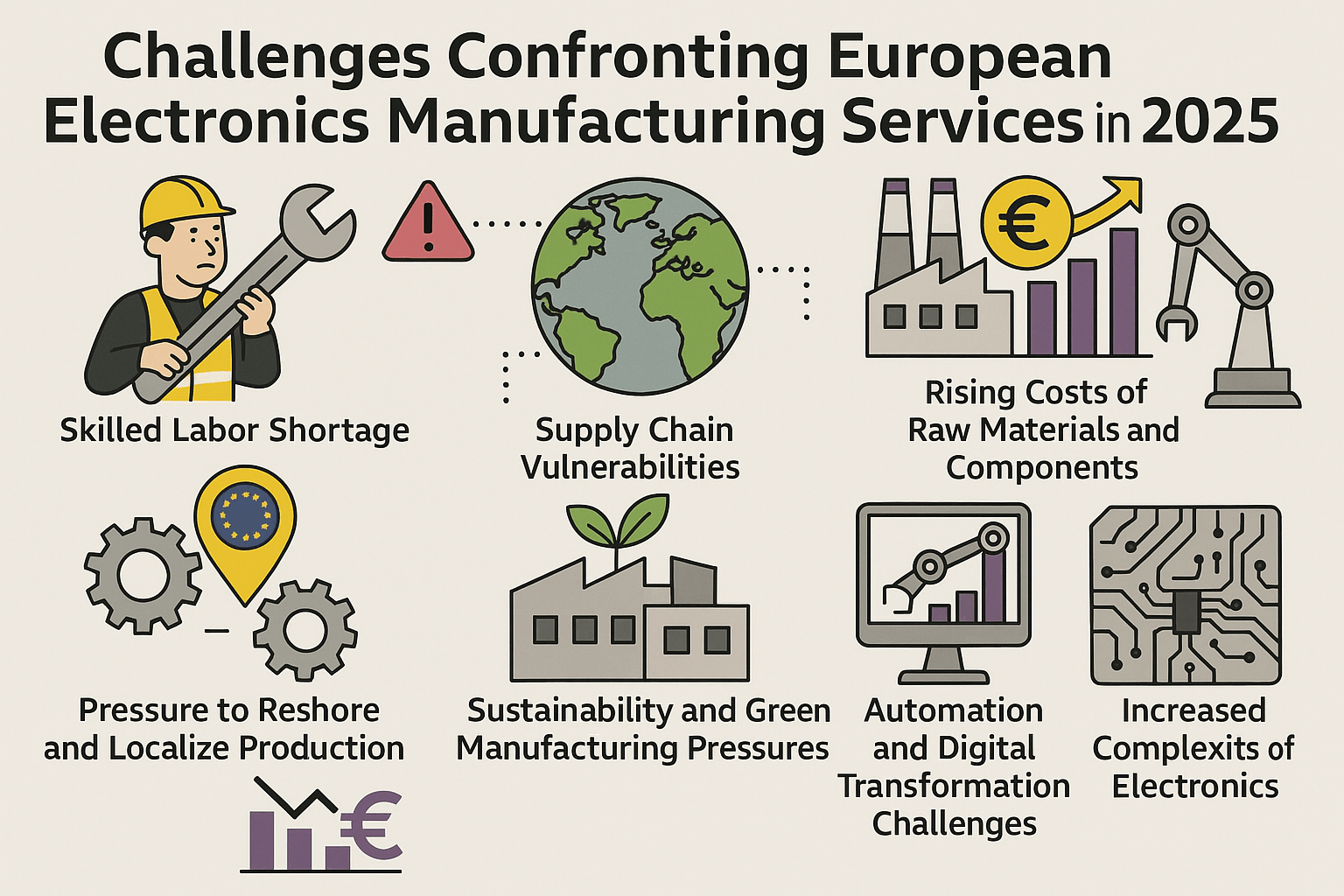
Supply Chain Resilience and Nearshoring: Recent volatility has accelerated the trend towards "local-for-local" manufacturing and nearshoring. OEMs are moving production closer to home to simplify logistics, improve oversight, and reduce exposure to geopolitical risks. However, new risks are emerging, such as potential US tariffs on electronics that could trigger another cycle of panic-buying if European firms lack procurement discipline.
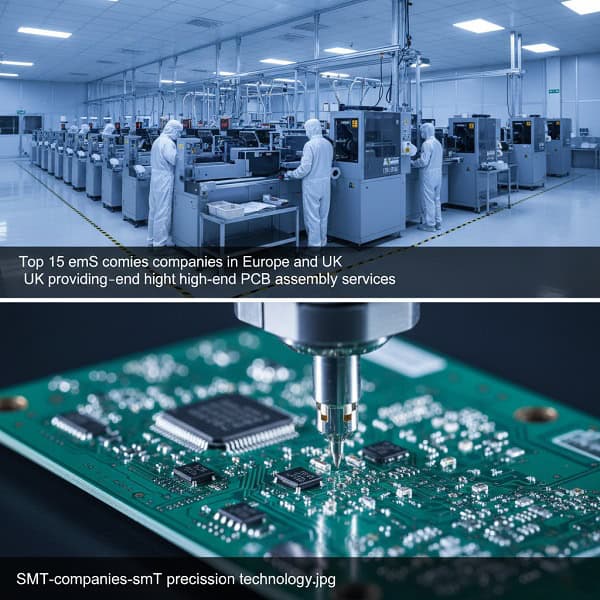
Automation and Technology: Investment in technology is critical to compete globally and offset high labor costs. Leading EMS providers are implementing fully automated SMT lines, cobot-equipped production cells, and smart logistics systems. This is crucial for achieving high efficiency, ultra-high density placements, and low defect rates through closed-loop inspection systems.
Regulatory and Environmental Pressures: The EU's stringent regulatory environment, including the "Green Deal," RoHS, and REACH standards, presents both a challenge and an opportunity. While compliance adds burdens, it also allows providers to differentiate themselves through sustainable practices. Mandatory ESG reporting and the push for a circular economy are forcing firms to adopt lead-free processes and robust recycling programs.
Reference:
- https://www.linkedin.com/pulse/europe-electronic-manufacturing-services-market-overview-2026-ktjff
- https://evertiq.com/news/2026-02-27-european-ems-downturn-continues-as-modest-recovery-eyed-for-2026
- https://evertiq.com/news/2025-11-21-is-poland-a-strong-choice-for-defence-electronics-manufacturing-in-2026
- https://www.cognitivemarketresearch.com/regional-analysis/europe-electronics-manufacturing-service-market-report
- https://www.evertiq.com/news/2025-09-20-ems-market-faces-downturn-but-cautious-optimism-for-2026
- https://www.linkedin.com/pulse/electronics-manufacturing-services-ems-market-size-share-forecast-l259f
- https://smttoday.com/wp-content/uploads/2025/04/Challenges-Confronting-European-Electronics-Manufacturing-Services-in-2025.png
- https://www.queenems.com/wp-content/uploads/2026/02/Precision-SMT-placement-by-ems-companies-for-high-reliability-medical-electronics.jpg
- https://www.linkedin.com/pulse/electronics-manufacturing-services-market-trends-2025-2035-77mxc
- https://www.queenems.com/post/top-15-ems-companies-in-europe-uk-2026-pcb-assembly-providers
- https://www.linkedin.com/pulse/europe-electronic-manufacturing-services-market-size-share-trends-growth-4gq9f
- https://www.linkedin.com/pulse/europe-electronics-manufacturing-services-market-insights-2026-xkjof
- https://www.verifiedmarketresearch.com/product/europe-electronic-manufacturing-services-market/
- https://www.linkedin.com/pulse/manufacturing-trends-2026-what-oems-need-know-v5eoc
- https://www.linkedin.com/pulse/electronics-manufacturing-services-market-size-share-0t0ff