Apr 15, 2026
PWM vs MPPT for RV Solar Systems: A Practical Look at Charging Efficiency and DC Circuit Breaker Protection
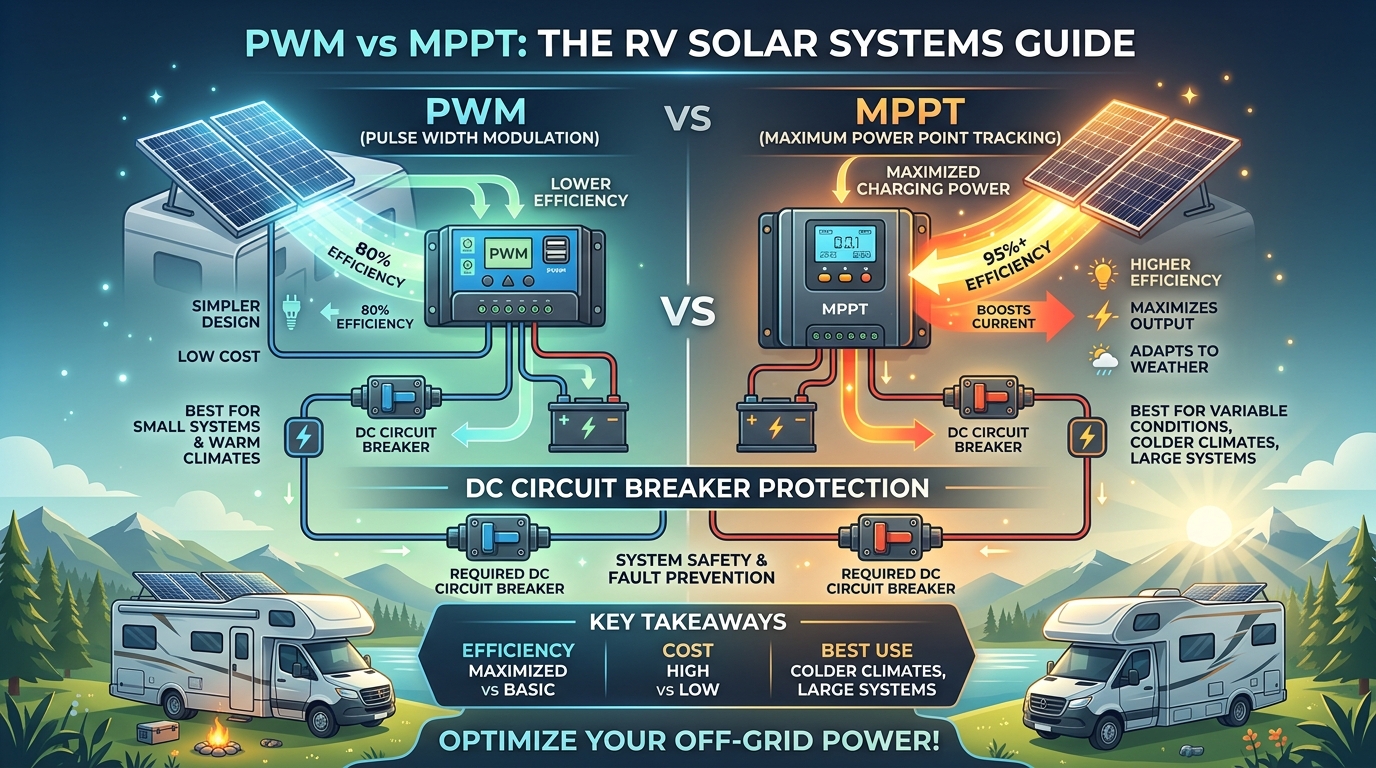
In RV and mobile living applications, solar power systems have become a common way to maintain electrical independence. Refrigerators, lighting, ventilation equipment, USB charging, and selected household devices often depend on a stable combination of solar panels, batteries, and power management components. In practice, however, system reliability is determined by more than panel wattage alone. The selection of a charge controller and the design of the protection architecture both have a direct effect on efficiency, battery performance, and operational safety.
Discussion around KUOYUH materials on PWM, MPPT, and DC circuit breaker protection points to two closely related issues. One is the difference between PWM and MPPT charge controllers. The other is the role of DC circuit breakers in protecting an RV solar system. Taken together, these considerations offer a clearer view of how an RV electrical system can be planned for stable charging, practical energy use, and safer power distribution.
What PWM and MPPT Mean in an RV Solar System
PWM stands for Pulse Width Modulation. MPPT stands for Maximum Power Point Tracking. Both are charge controllers designed to regulate the flow of energy from the solar panel to the battery. Their shared purpose is to manage battery charging, reduce the risk of overcharging, and support longer battery service life.
Both controller types can work with common battery categories such as flooded batteries, AGM, gel batteries, and LiFePO₄ lithium batteries. The central difference is not whether charging can occur, but how effectively available solar power can be converted into useful charging current.
| Type | Full Name | Operating Method | Main Characteristic |
|---|---|---|---|
| PWM | Pulse Width Modulation | Reduces solar panel voltage closer to battery voltage during charging | Lower cost and simpler structure |
| MPPT | Maximum Power Point Tracking | Tracks the panel’s maximum power point and converts excess voltage into usable charging current | Higher efficiency and better power utilization |
Functions Shared by Both Controller Types
PWM and MPPT controllers perform several core tasks that are fundamental to battery management:
- Prevent battery overcharge and over discharge
- Reduce reverse current flow to the solar panel at night
- Support multi stage charging such as bulk, absorption, and float
- Work with multiple battery chemistries used in RV systems
This means the real decision between the two is usually based on system efficiency, battery type, installation conditions, and energy demand rather than basic charging capability alone.
The Main Difference Between PWM and MPPT
How PWM Works
A PWM controller brings solar panel voltage down toward the voltage level required by the battery. This approach is straightforward and cost effective, but voltage that cannot be used for charging is effectively lost. In practical terms, that unused portion becomes heat rather than useful charging energy.
One example compares an 18V panel operating voltage with a 13.6V battery charging voltage. Under that condition, roughly one quarter of the available energy may not be converted into useful charging output. In strong midday sun and simple system conditions, PWM performance may still be acceptable. In colder weather, cloudy conditions, or lower light periods, the limitations become more noticeable.
How MPPT Works
An MPPT controller continuously tracks the solar panel’s maximum power point and converts surplus panel voltage into charging current that the battery can actually use. Efficiency gains typically range from 15% to 35%, with higher gains possible in some conditions.
This difference becomes more valuable when panel voltage changes with temperature, when sunlight varies throughout the day, or when wiring distance increases between the solar array and the battery system. In those cases, MPPT is better positioned to capture available energy and convert it into practical charging performance.
When PWM May Be Sufficient and When MPPT Is the Better Choice
The choice between PWM and MPPT is best understood through application rather than through price alone.
Situations Where PWM May Be Enough
PWM can remain a practical option when the RV system is relatively simple and power demand is modest. Lighting, USB charging, and other low load applications may not require the additional efficiency that MPPT provides. For users working within a limited budget, PWM can support a basic solar setup without adding unnecessary complexity.
Situations Where MPPT Offers Stronger Value
MPPT is generally better suited to systems that include lithium batteries, inverters, compressor refrigerators, water pumps, fans, or other loads that run for longer periods. It is also more suitable when the solar panel array is installed farther from the battery bank. In lithium based RV systems, MPPT is often treated as the more practical option because the charging profile and efficiency demands are better aligned with that controller type.
The following summary reflects common usage guidance for these systems:
| Use Case | More Suitable Controller | Reason |
|---|---|---|
| Basic lighting and USB charging | PWM | Lower cost and simpler setup |
| Refrigerators, pumps, and fans with long operating hours | MPPT | More stable output under changing sunlight |
| Systems that include an inverter for higher demand equipment | MPPT | Better energy use and faster battery recharge |
| LiFePO₄ battery systems | MPPT | Better alignment with lithium charging behavior and efficiency needs |
Wiring Configuration and Battery Type Also Affect Controller Selection
Controller selection is also closely tied to panel wiring method, battery chemistry, and installation layout.
In PWM systems, parallel panel wiring is more common and shorter wiring runs are generally preferred. In MPPT systems, higher input voltage can be used more effectively, which makes series wiring more attractive in many cases. This can reduce line loss, especially when the solar panels are mounted at a greater distance from the battery bank.
| System Factor | Common PWM Recommendation | Common MPPT Recommendation | Why It Matters |
|---|---|---|---|
| Panel wiring | Parallel | Series | Higher voltage can help reduce transmission loss |
| Battery type | Lead acid systems | LiFePO₄ systems | Lithium battery behavior aligns well with MPPT advantages |
| Wiring length | Preferably short | Can better tolerate longer runs | Lower line loss in extended wiring layouts |
Why DC Circuit Breakers Matter in RV Solar Systems
A DC circuit breaker should not be treated as an optional accessory. In RV solar systems, it serves as a core safety component within the overall electrical design.
An RV solar system uses direct current, and DC arc behavior makes fault conditions more difficult to manage than many users expect. If overcurrent, short circuit conditions, or reverse discharge are not properly controlled, the result may include overheated wires, damaged terminals, melted insulation, or in severe cases, fire.
A commonly used protection path can be described in the following form:
Solar Panel → DC Circuit Breaker → PWM or MPPT → DC Circuit Breaker → Battery → Load or Inverter
This layout shows that each breaker position serves a different protection function:
| Breaker Position | Protection Purpose |
|---|---|
| PV side breaker | Protects the controller from panel faults or short circuits |
| Battery side breaker | Protects the controller from reverse discharge from the battery |
When an RV system also includes a vehicle alternator, a DC DC charger, shore power charging, or an inverter, the importance of breaker placement increases further. Multiple power sources may feed into the same battery bank, which means wiring and terminals may carry more current than a user would estimate from one charging source alone.
How to Select a DC Circuit Breaker Rating
A useful sizing reference is:
Circuit breaker rating = maximum system charging current × 1.25 to 1.4
For example, if an MPPT controller has a maximum output current of 35A, the suggested breaker range would be 40A to 50A. If the system includes an inverter or motor driven loads, a factor closer to 1.4 to 1.6 can provide more room for startup current and load variation.
This recommendation reflects a practical balance. The breaker must not trip too easily during normal operation, but it still needs to disconnect the circuit before wiring or connected equipment is exposed to unsafe current conditions.
Looking at Controller Choice and Protection as One System
If the discussion is limited to controller specifications alone, it is easy to overlook how closely efficiency and protection are connected. In an RV solar installation, controller type, battery chemistry, panel wiring, cable length, and breaker placement all influence one another.
PWM remains a workable solution for lower power and simpler system requirements. MPPT becomes more compelling when the system uses lithium batteries, supports an inverter, or is expected to perform reliably in varied travel conditions. In either case, DC circuit breakers should be treated as essential rather than optional because they protect not only individual components, but the wider electrical system and the vehicle itself.
Conclusion
For RV users, the difference between PWM and MPPT is primarily a matter of energy efficiency, installation conditions, and system demand rather than a simple question of entry level versus advanced equipment. PWM can still support small and budget conscious systems. MPPT is generally the stronger option for lithium battery setups, inverter based systems, and applications where charging efficiency has a direct effect on daily usability.
Protection design deserves equal attention. A solar charging system should not be evaluated only by the controller it uses. Proper overcurrent protection, isolation strategy, and breaker sizing are all part of a complete and safer electrical architecture. When controller selection and protection planning are addressed together, an RV solar system is better positioned to deliver stable charging, more reliable operation, and improved long term safety.