Custom Server Cabinets in the AI Era
Feb 01, 2026
AI and high-density computing are transforming what "good" looks like in a server cabinet. Buyers can no longer treat enclosures as a commodity purchase. Airflow, serviceability, load strength, and de...
Custom Server Cabinets in the AI Era: How Procurement Teams Can Reduce Risk, Control Costs, and Speed Deployment
AI and high-density computing are transforming what "good" looks like in a server cabinet. Buyers can no longer treat enclosures as a commodity purchase. Airflow, serviceability, load strength, and delivery certainty now directly affect uptime, operating cost, and project schedules.
This guide blends industry trends with procurement-ready checklists, then shows how Machan approaches complex OEM cabinet builds.
Why Custom Server Cabinets Are Now Strategic Infrastructure

Data centers are expanding fast and carrying heavier thermal loads. Higher-density hardware brings new constraints:
- More heat per rack demands better airflow design and containment compatibility.
- Shorter product cycles mean procurement cannot afford long prototype loops.
- Racks are the physical platform for power, cooling, and cable management, so any flaw spreads risk across the entire stack.
Procurement teams now have to buy cabinets as engineered systems, not just sheet metal.
What Procurement Teams Struggle With (and How to Fix It)
-
Standards compliance vs. real-world fit The 19-inch rack standard defines width and mounting holes, but depth is not standardized. Fix: Require explicit depth and clearance diagrams and verify equipment fit early.
-
Thermal performance risk A cabinet can pass dimensional checks yet still fail operationally if airflow is wrong. Fix: Ask how front-to-rear airflow is preserved and how hot/cold aisle containment is supported.
-
Load and serviceability Rails, slides, and access panels are where many failures happen. Fix: Insist on load-testing and clear service access requirements.
-
Late engineering changes Procurement delays often stem from design edits after the first prototype. Fix: Require DFM/DFX reviews and milestone-based design freeze points.
-
Hidden TCO Low-price cabinets can drive high OPEX: dust buildup, inefficient airflow, or hard maintenance. Fix: Evaluate lifecycle impact, not just unit price.
Trend Watch: What’s Changing the Cabinet Spec
-
Higher Power Density AI and accelerated computing raise heat load per rack, making airflow design a procurement requirement.
-
Containment and Airflow Integration Most large installations now use hot-aisle/cold-aisle setups. Cabinets must support these strategies.
-
Modular Expansion Facilities expect fast, modular expansion. Cabinets must be easy to reconfigure, scale, and service.
-
Reliability Expectations Redundancy and dual-feed power are standard practice. Cabinets must accommodate those layouts.
Procurement-Ready Spec Table (Example)
Use this to structure RFQs and compare vendors.
Category: Standards and Dimensions
- Rack Standard: EIA-310 / IEC 60297 compliant
- Height: 42U (example)
- Width: 600 mm / 800 mm
- Depth: 800 mm / 1000 mm
- Mounting Rail: Adjustable depth, square-hole with cage nuts
Category: Thermal and Airflow
- Airflow Direction: Front-to-rear
- Containment Compatibility: Hot aisle / cold aisle supported
- Door Type: Perforated front, sealed rear (as required)
- Filters: Optional dust filtration
Category: Structural
- Static Load Rating: 1,200 kg
- Dynamic Load Rating: 600 kg
- Material: Steel + aluminum hybrid
- Rail Capacity: 70 kg per slide
Category: Serviceability
- Access Panels: Tool-free side panels
- Cable Management: Zero-U cable channels
- PDU Support: Dual-feed vertical PDU rails
Category: Compliance and Validation
- Testing: Load test + airflow validation
- Quality Gates: First article inspection + pilot run
This makes apples-to-apples comparisons easier and protects you from hidden risk.
Case Insight: Machan’s Approach to a High-Precision Cabinet OEM
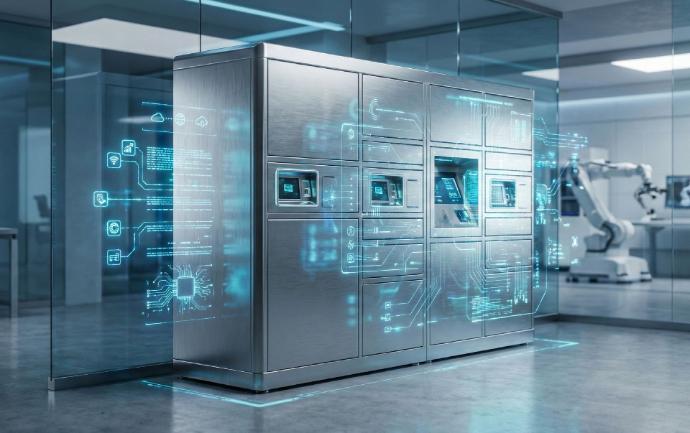 Machan’s recent OEM project involved a high-end server cabinet used in a cleanroom environment. The client needed zero cable pinch risk and a high load capacity, all within strict weight limits.
Machan’s solution included:
- Hybrid aluminum + steel structure to balance weight and strength
- Simulation-based validation for joint strength and load distribution
- Reinforced rails and supports to reach 70 kg load capacity
- Less than 90-day turnaround from first meeting to sample shipment
This reflects a procurement-friendly process: co-design early, validate fast, and deliver stable mass production.
Why Machan Fits Procurement Pain Points
Machan aligns with what buyers need most:
- Co-design support to reduce late-stage changes
- Manufacturing discipline with clear milestones and QC gates
- Material expertise for strength-to-weight optimization
- Proven OEM experience across enclosure categories
Final Takeaway
For procurement teams, the real risk is not price, it is a cabinet that fails under operational reality. A good custom cabinet reduces thermal risk, simplifies maintenance, and speeds deployment.
If your next project needs reliability, fast validation, and manufacturing stability, a partner like Machan can eliminate the typical procurement bottlenecks.
References