Apr 15, 2026
How to Choose the Right Oil Seals for Industrial Equipment? 5 Key Selection Indicators Explained
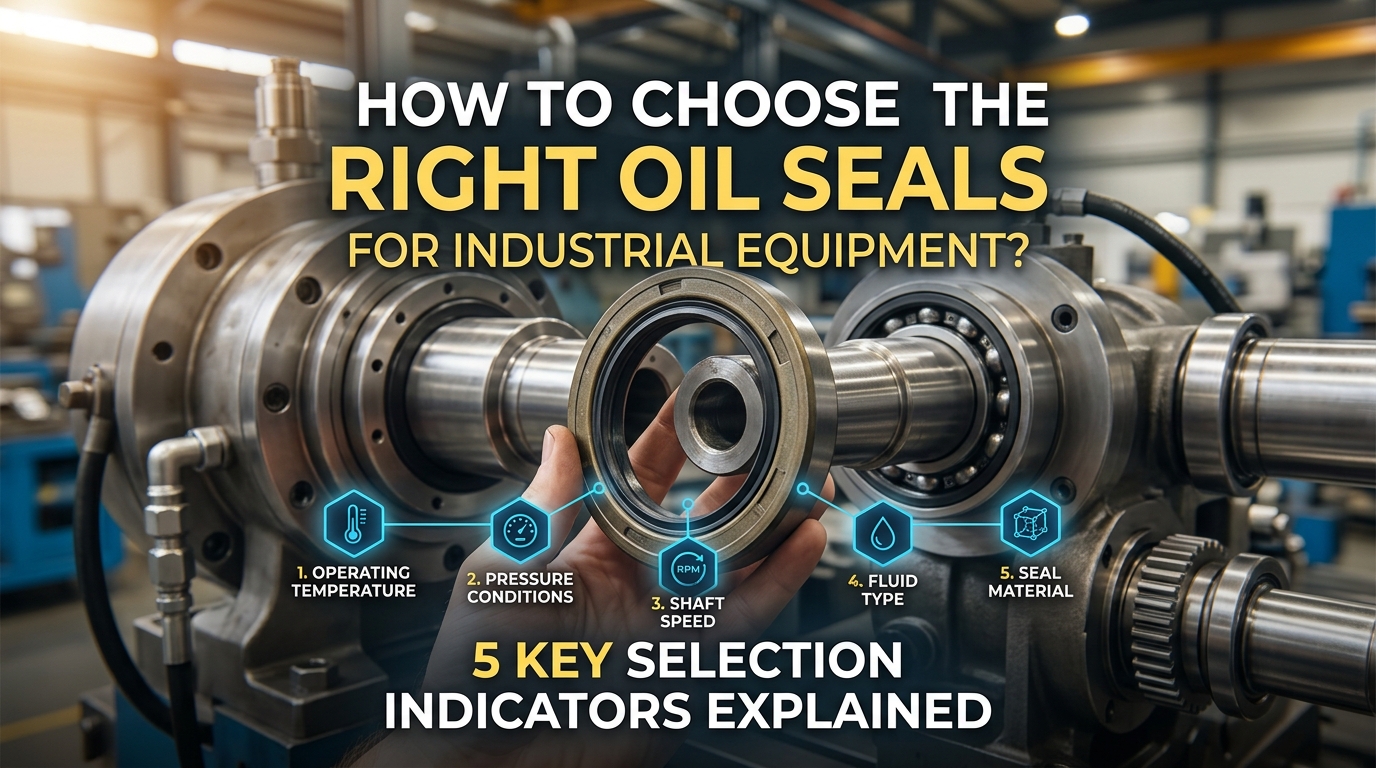
Selecting an oil seal for industrial equipment is not only a purchasing matter. In many applications, it directly affects lubricant retention, contamination control, component protection, maintenance intervals, and equipment availability. A seal that does not match the operating conditions may contribute to leakage, shaft wear, bearing damage, or unplanned shutdowns.
This article reviews five commonly used evaluation factors in oil seal selection: shaft precision, rotational speed, operating temperature, internal pressure, and media compatibility. It also summarizes current developments in sealing technology and lists representative manufacturers for reference.
Why Oil Seal Selection Matters in Industrial Equipment
Oil seals are used to retain lubricants and help prevent external contaminants such as dust, moisture, and process debris from entering rotating equipment. Although they are relatively small components, their performance can influence the reliability of gearboxes, pumps, motors, reducers, and other shaft driven systems.
In many cases, premature seal failure is associated with a mismatch between seal design, material selection, and actual service conditions rather than with a manufacturing defect alone. For this reason, selection should be based on measurable operating data, shaft condition, and material characteristics instead of dimensions alone.
1. Shaft Precision and Surface Finish
Shaft condition is one of the primary factors affecting sealing performance. In rotary lip seal applications, the sealing interface depends on a thin lubricant film at the shaft surface. If the shaft is too rough, the lip may wear rapidly. If the surface is excessively smooth, the lubricant film may become less stable under certain operating conditions, which can increase friction and local heat generation.
According to ISO 6194-1:2022, shaft surface finish, hardness, and dimensional tolerance should be controlled within suitable ranges for rotary shaft lip type seals incorporating elastomeric elements. In general industrial applications, a shaft hardness of at least 45 HRC is often used as a practical reference value. In high speed or abrasive environments, higher hardness may be considered to reduce the risk of shaft grooving.
| Parameter | Common Reference Range | Potential Risk if Out of Range |
|---|---|---|
| Surface Roughness (Ra) | 0.2 to 0.8 µm | Excessive lip wear or unstable lubricant film |
| Shaft Hardness | ≥ 45 HRC | Shaft grooving and long term leakage path |
| Shaft Tolerance | ISO h11 or better | Eccentric rotation and uneven lip load |
Actual shaft requirements should still be confirmed against the seal manufacturer’s design data and the intended operating environment.
2. Rotational Speed and Surface Velocity
Seal speed limits are generally evaluated by surface velocity rather than RPM alone. Even when two shafts rotate at the same RPM, a larger shaft diameter produces a higher peripheral speed at the sealing contact area.
As surface velocity rises, heat generated at the lip contact area may also increase. If the selected material or lip design is not suitable for the operating speed, hardening, wear, and reduced sealing performance may occur earlier.
The calculation commonly used is:
V (m/s) = (π × D × n) / 60,000
Where D is shaft diameter in millimeters and n is rotational speed in RPM.
Market analyses such as the Grand View Research industrial seals market report indicate that high speed motors and automation equipment are contributing to increased demand for PTFE based sealing materials in some applications. In general terms, PTFE based sealing elements can tolerate higher surface velocities than standard NBR compounds, though actual limits depend on seal geometry, lubrication state, shaft finish, pressure, and cooling conditions.
3. Operating Temperature
Temperature has a direct effect on elastomer stability, wear behavior, and sealing life. Selection should not rely only on sump or oil reservoir temperature. The contact area beneath the seal lip can operate at a higher temperature because of friction and shaft motion.
When material temperature exceeds its practical operating range, elasticity may decline and the lip may lose some of its ability to follow shaft movement. This can increase the probability of leakage.
Common material references include:
- NBR: often used up to around 100°C in general industrial oil sealing applications
- FKM: commonly selected for higher temperature environments, often up to around 200°C depending on compound grade and media
- HNBR: typically used where improved heat resistance and wear resistance are needed compared with standard NBR
Temperature capability should always be checked against the actual compound grade, fluid chemistry, shaft speed, and application design. Information published by material suppliers and industry associations such as the Rubber Manufacturers Association is commonly used as a general reference, but final material selection should rely on application specific data.
4. Internal Pressure and Load Conditions
Most standard rotary oil seals are intended for low pressure service. In many catalog references, standard designs are used in environments below approximately 0.03 MPa. When internal pressure rises or fluctuates, the sealing lip may deform, lose contact stability, or invert.
In gearboxes, pumps, and hydraulic related systems, pressure pulses should be considered during selection. For applications with pressure loading, reinforced designs or pressure type seals are often preferred. Housing rigidity, shaft runout, misalignment, and venting conditions may also influence sealing performance.
In recent years, some industrial monitoring systems have used pressure, temperature, and vibration data to estimate equipment condition and maintenance timing. In sealing related applications, such monitoring may support condition based maintenance where suitable sensor data is available.
5. Media Compatibility and Chemical Resistance
Compatibility between the sealing material and the lubricant or process media is a basic requirement in seal selection. Incompatible media may cause swelling, shrinkage, softening, hardening, or accelerated material degradation.
For example, mineral oil systems are commonly paired with NBR or HNBR, while water based or steam related environments may require different compounds such as EPDM. In more aggressive chemical conditions, PTFE or FFKM may be evaluated depending on operating temperature, pressure, motion, and cost considerations.
| Media Type | Commonly Used Material | General Reason |
|---|---|---|
| Mineral Oils | NBR, HNBR | Good resistance to many petroleum based lubricants |
| Biodegradable Oils | FKM | Often considered where broader chemical resistance is required |
| Water or Steam | EPDM | Suitable for many polar media applications |
| Aggressive Chemicals | PTFE, FFKM | Broad chemical resistance in demanding environments |
These material pairings are general references only. Final material choice should be confirmed using the actual fluid formulation, additive package, temperature range, and supplier compatibility data.
Developments in Sealing Technology
Current sealing technology continues to evolve in response to higher equipment speeds, longer maintenance intervals, and environmental compliance requirements.
One area of development is the use of digital simulation and digital twin models in seal design and application analysis. Manufacturers may use these tools to estimate lip load, wear tendency, and material response under defined operating conditions.
Another area of attention is the development of PFAS free elastomer formulations and other alternative material systems in response to regulatory and sustainability considerations. Industry publications, including coverage in Sealing Technology, have noted increasing attention to these material transitions.
FAQ
Can FKM be used as a universal oil seal material?
Not in every case. FKM offers strong heat resistance and compatibility with many oils and chemicals, but it may be less suitable in very low temperature environments or with certain specialized fluids. Material selection should match the actual operating conditions.
How can dry running related seal damage be identified?
A seal affected by insufficient lubrication at the lip contact area may show heat related damage such as hardening, cracking, glazing, or irregular lip deformation. Inspection of the shaft surface, lubrication state, and installation condition is also important before identifying the failure cause.
How does shaft runout affect oil seal life?
Shaft runout increases dynamic movement at the lip contact area. If runout exceeds the material and design tolerance, contact stability may decline and wear may increase. Acceptable limits depend on shaft size, speed, seal type, housing arrangement, and operating condition.
Global Manufacturers and Sealing Solution Providers
The following companies are widely recognized in sealing technology and industrial sealing applications. Their product portfolios, material capabilities, and industry focus vary by market and application.
-
SKF A global manufacturer of bearings, lubrication systems, and sealing products. SKF is widely known for integrated rotating equipment solutions used across industrial and automotive sectors.
-
Freudenberg Sealing Technologies A major sealing technology company with broad expertise in elastomer materials, industrial sealing systems, and automotive applications. The group is closely associated with the Simmerring product line.
-
Trelleborg Sealing Solutions A supplier of engineered polymer sealing solutions serving industries such as aerospace, industrial equipment, and fluid power. Its portfolio includes seals for demanding mechanical and chemical environments.
-
Parker Hannifin An international motion and control technologies company that provides sealing products alongside hydraulic, pneumatic, and filtration systems for a wide range of industries.
-
Garlock Sealing Technologies A manufacturer focused on fluid sealing, gasket materials, and reliability solutions for process industries, heavy industry, and rotating equipment applications.
-
Lian Yu Seal A Taiwan based manufacturer specializing in oil seals, O rings, rubber parts, and custom sealing components. The company serves industrial applications that require standard and customized elastomer sealing solutions.
-
Hallite Seals A company known for hydraulic and pneumatic sealing systems, with a product range commonly used in mobile equipment, construction machinery, and industrial cylinders.
-
NOK Corporation A Japan based sealing manufacturer with long standing experience in oil seals, functional parts, and automotive sealing technologies. It has a significant presence in vehicle and machinery supply chains.
-
Dichtomatik A sealing distributor and supply platform associated with the Freudenberg Group, providing standard sealing products and industrial components with broad market availability.
-
Federal-Mogul A historic industrial and automotive brand known for engine, powertrain, and sealing related components. Current brand and product operations are associated with Tenneco.
-
Kastas Sealing Technologies A sealing manufacturer supplying hydraulic, pneumatic, and custom engineered sealing products for industrial machinery and fluid power systems.
Conclusion
Oil seal selection should be based on operating data, shaft condition, fluid characteristics, and equipment load rather than part dimensions alone. Evaluating shaft precision, surface velocity, temperature, pressure, and media compatibility can help reduce leakage risk and improve service stability.
For engineering, maintenance, and procurement teams, a practical review process may include the following:
- Check failure records for recurring patterns in specific machines or duty cycles
- Confirm lubricant and additive compatibility with the selected elastomer
- Review shaft finish, hardness, runout, and housing condition during replacement planning
- Consult seal manufacturers or technical suppliers when the application involves high speed, high temperature, pressure fluctuation, or aggressive media
A structured selection process can support longer service life and more predictable maintenance performance.