Apr 15, 2026
PCB Supply Chain Shift in 2026: Why Copper Plating Stability Matters More Than Factory Relocation
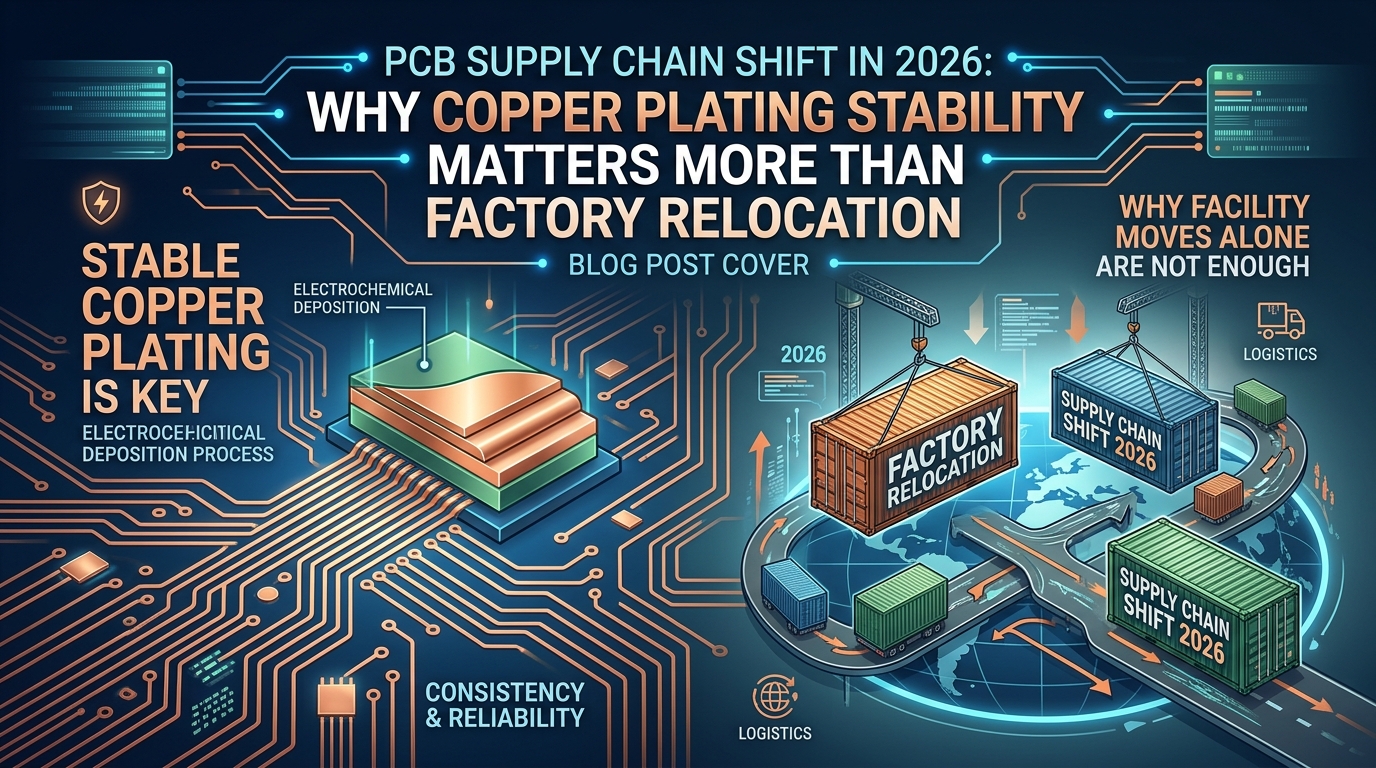
The global PCB industry is entering a new phase in 2026. Over the past two years, many manufacturers have focused on production relocation, regional diversification, and new factory setup. That movement remains important, but the competitive focus is changing. The discussion is no longer limited to where production is located. It is increasingly about whether new production bases can maintain stable yield, consistent process control, and reliable quality under more demanding product requirements.
For contract manufacturing businesses, this shift deserves attention. Customers in electronics, networking, automotive, industrial control, and computing are asking for more than available capacity. They want predictable manufacturing performance. In PCB production, that means process stability across every critical step, especially copper plating.
This industry direction is consistent with observations discussed in Pan-Continental Chemical’s article, "Not Just Relocation, but Reshaping: Why 2026 is the Critical Turning Point for the PCB Supply Chain", which highlights the growing importance of yield stability, copper plating chemistry, and material purity as PCB manufacturing expands into new regional bases.
Why 2026 Marks a Turning Point for PCB Manufacturing
The years 2024 and 2025 were largely defined by supply chain relocation. Companies expanded or shifted production to Southeast Asia to reduce concentration risk and improve customer responsiveness. Thailand, Malaysia, and Vietnam became major destinations for new PCB and electronics investment.
By 2026, however, relocation alone is no longer enough. Once a facility is operating, customers begin to evaluate actual production performance. This includes line stability, defect rates, repeatability, engineering support, and the ability to handle advanced board designs at scale.
According to the cited Pan-Continental Chemical article, 2026 represents the point at which PCB factories are judged less by construction speed and more by yield stability, chemical control, and the ability to support advanced copper plating processes required by next generation electronics.
Why Copper Plating Chemistry Is Under More Pressure
Modern PCB applications are placing much greater pressure on plating processes. High layer count boards, high density interconnect designs, deep vias, fine features, and tighter electrical requirements all make plating stability more difficult to maintain.
In practical terms, a plating process must deliver uniform copper deposition throughout the board structure. If copper distribution becomes uneven, manufacturers may face voids, weak via walls, rough surfaces, or microstructural defects. These issues can reduce yield in production and may also create reliability problems in the field.
The source article points out that high layer count AI boards, deep vias, and ultra fine circuitry place unusual stress on plating baths. It also notes that raw material quality is no longer only a purchasing issue because the purity and dissolution behavior of copper oxide can directly influence plating uniformity, bath lifetime, and defect rates.
Southeast Asia Expansion Brings Opportunity and New Process Risks
Southeast Asia continues to gain importance in the PCB supply chain. The region offers strategic benefits such as geographic diversification, labor availability, and proximity to growing electronics ecosystems. However, rapid expansion also introduces a practical challenge. Building capacity is faster than building stable process maturity.
Different production sites may use different upstream suppliers, local operating practices, water quality conditions, and technical support systems. These variations can influence plating bath performance and overall process consistency. For manufacturers serving global customers, this creates a new operational question: can the same quality standard be maintained across regions and across production batches?
Pan-Continental Chemical’s analysis specifically discusses Thailand, Malaysia, and Vietnam as emerging PCB manufacturing bases. It argues that as these regions mature, the limiting factor is no longer machinery alone, but chemical consistency across batches and across suppliers.
Material Purity Is Becoming a Qualification Factor
As PCB designs become more demanding, material purity is receiving more attention during supplier evaluation. In copper plating, the quality of upstream chemical inputs can influence dissolution behavior, ion balance, contamination risk, and bath lifetime.
For manufacturers, this is not only a chemistry issue. It is also a production risk issue. If a copper source introduces particulates, impurities, or unstable dissolution characteristics, the plating process may become harder to control. That can affect deposit uniformity, grain structure, surface morphology, and long term reliability.
The referenced article further notes that qualification audits increasingly examine upstream chemical supply reliability. This reflects a broader industry trend in which a factory without stable access to high purity plating materials may be viewed as a production risk, regardless of equipment investment.
How AI, ASIC, and High Speed Electronics Raise the Standard
The growth of AI servers, custom computing platforms, and high speed network infrastructure is raising the standard for PCB production. These applications often require more layers, more complex interconnect structures, and tighter electrical performance.
In AI and ASIC related boards, plating quality plays a major role in via integrity and structural consistency. Boards with deeper vias and tighter geometries need stable copper distribution throughout the hole wall. Small process variations can create defects that are difficult to detect early but costly when they appear in reliability testing or end use.
The cited source also links AI platforms, ASIC development, LEO satellite systems, and advanced telecom infrastructure with rising demand for high purity copper oxide, stable copper ion balance, and smooth, uniform copper deposition. These requirements reflect a broader shift toward tighter material and process control in advanced PCB manufacturing.
What This Means for Contract Manufacturing Businesses
For a blog focused on manufacturing services and processing partnerships, the main takeaway is clear. The PCB supply chain in 2026 is shifting from expansion logic to execution logic. Capacity still matters, but stable execution matters more.
This creates several priorities for contract manufacturing businesses:
1. Evaluate process capability, not only location
Regional diversification remains important, but site selection should include plating stability, yield history, and technical support depth.
2. Review upstream material consistency
Raw material quality can affect downstream yield and reliability. Procurement decisions in chemistry should be aligned with engineering and quality requirements.
3. Strengthen cross site standardization
If manufacturing is spread across multiple regions, process windows and supplier standards need strong alignment to reduce variation.
4. Prepare for stricter customer audits
Customers are increasingly reviewing chemical control, traceability, and risk management in addition to capacity and lead time.
5. Connect process detail to customer value
Yield stability, defect reduction, and reliability performance are not only internal metrics. They directly affect delivery confidence, total cost, and long term partnership value.
Conclusion
The PCB supply chain shift in 2026 is not simply about moving factories from one region to another. It reflects a broader change in what defines manufacturing competitiveness. As product requirements become more complex, stable yield and process consistency are taking priority over expansion speed alone.
Copper plating sits at the center of this shift. It connects raw material quality, process control, board reliability, and final application performance. For contract manufacturing companies, understanding this relationship is increasingly important when selecting suppliers, building regional capacity, and responding to customer expectations.
As discussed in the Pan-Continental Chemical article, the next phase of PCB manufacturing will reward organizations that understand the connection between chemical inputs and system level reliability. For the broader contract manufacturing sector, this serves as a useful reminder that manufacturing success depends not only on capacity expansion, but also on disciplined process control and stable material performance.
Source Reference
- Pan-Continental Chemical. Not Just Relocation, but Reshaping: Why 2026 is the Critical Turning Point for the PCB Supply Chain