Jun 24, 2026
Zinc Oxide in Industry: Applications Across Rubber, Coatings, Electronics, and Personal Care
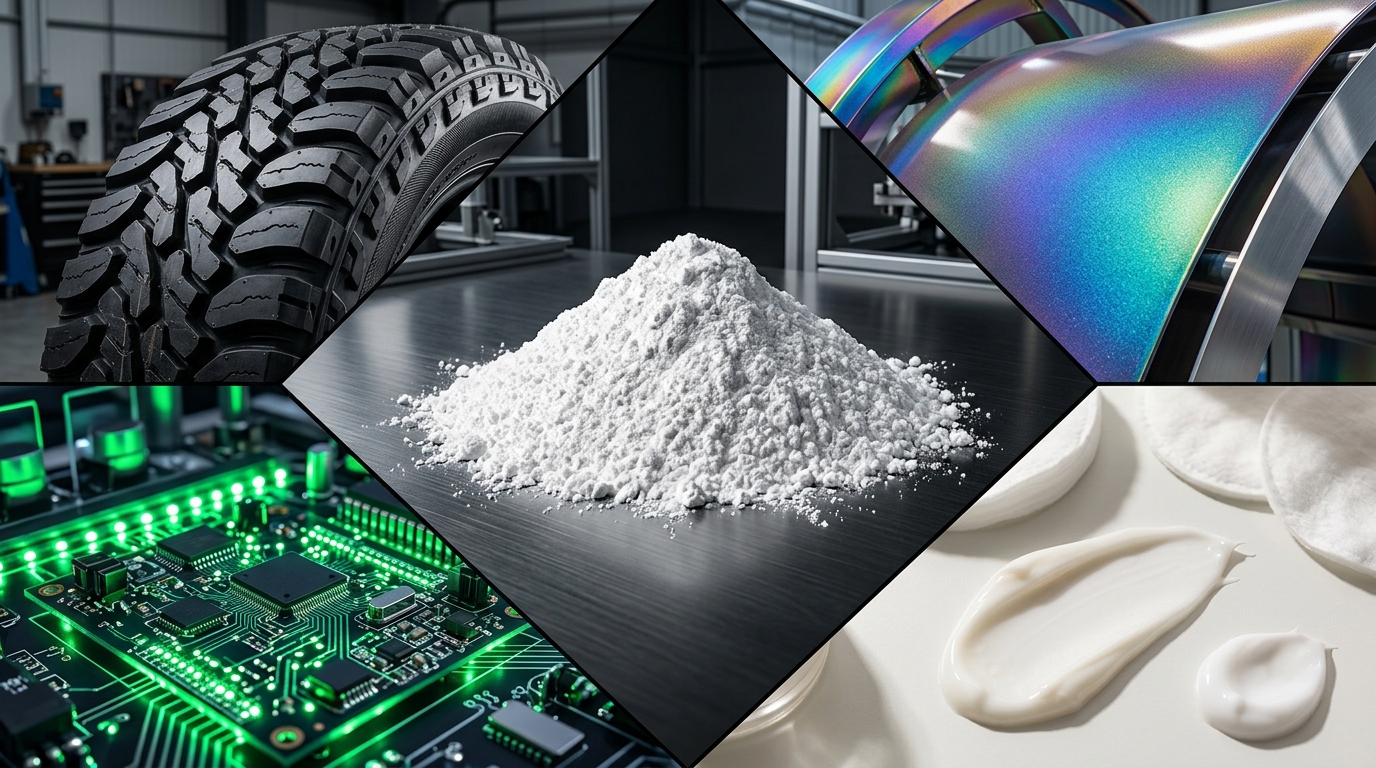
Zinc oxide (ZnO) is one of the most versatile inorganic compounds in industrial chemistry. With a unique combination of semiconducting, piezoelectric, and chemical reactivity properties, it functions as an activator, catalyst, UV absorber, antimicrobial agent, and semiconductor across a remarkably wide range of manufacturing sectors.
For chemical procurement professionals and formulation engineers, understanding ZnO's performance characteristics across different application segments — and the quality specifications that distinguish industrial grades from specialty grades — is essential to supplier qualification and product consistency.
The Chemistry Behind Zinc Oxide's Versatility
Zinc oxide is an amphoteric metal oxide: it reacts with both acids and bases, giving it broader compatibility across formulation chemistries than most metal oxides. Its key physicochemical properties include:
- Band gap: ~3.37 eV (direct, wide bandgap semiconductor)
- Refractive index: ~2.0, contributing to opacity and UV absorption
- Crystal structure: Wurtzite hexagonal, with piezoelectric properties
- Density: 5.6 g/cm³
- Solubility: Practically insoluble in water, soluble in dilute acids and strong alkalis
The variation in manufacturing method — indirect process (French process), direct process (American process), wet chemical process, or hydrometallurgical routes — produces ZnO powders with distinct surface area, purity, particle size distribution, and morphological characteristics. These variables are not cosmetic: they directly determine performance in end applications.
Active zinc oxide (produced via the wet chemical/hydrometallurgical route) typically features higher specific surface area (BET surface area > 40 m²/g) compared to standard indirect process zinc oxide (typically 3–6 m²/g). This higher surface area translates to enhanced reactivity in rubber vulcanization, improved dispersion in coatings formulations, and better catalytic efficiency.
Application 1: Rubber Vulcanization
The largest single industrial use of zinc oxide globally is as a vulcanization activator in rubber compounding. The mechanism is well-understood: ZnO reacts with stearic acid (or other organic acids) to form zinc stearate in situ, which acts as the activating agent for sulfur-based vulcanization systems.
In practical terms, the rubber compounder typically uses ZnO at loading levels of 3–5 phr (parts per hundred rubber) for natural rubber and synthetic rubber compounds including SBR, EPDM, NBR, and neoprene.
Key performance implications of ZnO quality in rubber:
Particle size and surface area: Finer ZnO with higher BET surface area activates vulcanization more efficiently, potentially allowing reduced loading levels without performance compromise — relevant when minimizing material costs in high-volume automotive seals, hoses, and tire compounds.
Purity: Heavy metal contaminants (lead, cadmium, mercury) in ZnO create regulatory issues under REACH, RoHS, and automotive supply chain requirements including IMDS (International Material Data System). Electronic grade and low-heavy-metal ZnO specifications are increasingly required throughout the automotive Tier 1 and Tier 2 supply chain.
Consistency: Vulcanization kinetics are sensitive to ZnO surface chemistry. Batch-to-batch variation in surface area and reactivity introduces cure time variability that complicates automated rubber processing. Procurement teams qualifying ZnO suppliers should request process capability data (Cpk) for surface area and particle size distribution alongside standard chemical specification sheets.
Application 2: Anti-Corrosion and Protective Coatings
Zinc oxide has a long history in protective coatings as a corrosion-inhibiting pigment. ZnO participates in corrosion protection through several mechanisms:
- Passivation: ZnO reacts with moisture to form zinc soaps that seal the metal-coating interface
- Sacrificial protection: In zinc-rich formulations, zinc metal particles (supplemented with ZnO) provide cathodic protection
- UV absorption: ZnO absorbs UV radiation, protecting underlying organic binder systems from photodegradation
In industrial maintenance coatings, ZnO is used in primers for steel structures, marine coatings for ship hulls and offshore equipment, and powder coatings for agricultural and construction equipment.
The shift toward low-VOC and waterborne coatings systems has renewed interest in ZnO's compatibility with water-based alkyd and acrylic binder systems. Nano-sized ZnO particles (< 100 nm) are being evaluated for enhanced UV absorption and antimicrobial properties in functional coatings, though regulatory status for nano-ZnO under REACH remains an evolving area requiring supplier disclosure.
Application 3: Electronics and Semiconductors
Zinc oxide's semiconducting properties make it a candidate material for several electronics applications:
Varistors: ZnO-based metal oxide varistors (MOVs) are the dominant technology for transient voltage suppression in power electronics, consumer electronics, telecommunications equipment, and industrial control systems. The grain boundary structure between ZnO granules creates the non-linear current-voltage characteristic that makes MOVs effective surge protectors. ZnO purity, dopant composition (typically bismuth, cobalt, manganese, and other oxides), and particle size distribution are tightly specified for varistor production.
Transparent conductive films: Aluminum-doped ZnO (AZO) is studied as a low-cost alternative to indium tin oxide (ITO) in thin-film solar cells and flat-panel display applications. Taiwan's photovoltaic and display industries create proximity-based demand for high-purity ZnO precursors.
Piezoelectric applications: ZnO's piezoelectric characteristics enable use in acoustic wave sensors, MEMS devices, and thin-film actuators.
PCB manufacturing: Zinc compounds, including copper-zinc systems, are used in specialized PCB surface treatment processes.
Application 4: Personal Care and Pharmaceutical Formulations
Zinc oxide has regulatory status as an approved active ingredient in multiple personal care categories:
Sunscreens: ZnO is one of only two FDA-approved inorganic UV filters (alongside titanium dioxide) for over-the-counter sunscreen products in the US market. Its broad-spectrum UV absorption (UVA and UVB) and favorable skin tolerability profile have made it the preferred sunscreen active in mineral sunscreen formulations, which have grown substantially in consumer preference as organic UV filter safety questions have emerged.
Wound care: Pharmaceutical-grade ZnO is used in zinc oxide ointments, diaper rash products, and wound dressings. Its astringent, antimicrobial, and skin-barrier properties are well-documented.
Dental applications: Zinc oxide eugenol (ZOE) cement is a foundational dental restorative and impression material.
Personal care and pharmaceutical ZnO requires highest purity grades, heavy metal specifications consistent with USP/BP pharmacopeia standards, and clean manufacturing documentation.
Sustainable Zinc Oxide: The 2026 Procurement Perspective
Environmental and supply chain sustainability is reshaping chemical procurement across all sectors. For zinc oxide specifically, several developments are relevant:
Secondary zinc sources: ZnO produced from recycled zinc feedstocks (including electric arc furnace dust and zinc die-casting scrap) offers a lower primary resource intensity. With appropriate purity specification and contamination control, secondary-source ZnO meets most industrial grade requirements.
ZDHC MRSL compliance: For manufacturers supplying the footwear, textile, and apparel sectors, chemical suppliers must demonstrate conformance with the ZDHC Manufacturing Restricted Substances List. Zinc compounds have specific reporting requirements under ZDHC frameworks relevant to suppliers in those value chains.
Carbon footprint documentation: Scope 3 emissions accounting is pushing chemical buyers to request environmental product declarations (EPDs) and Product Carbon Footprints (PCFs) from ZnO suppliers. Hydrometallurgical ZnO manufacturing routes that utilize lower-temperature processes and cleaner energy sources can document lower carbon intensity.
Conflict minerals: Zinc is not a designated conflict mineral under the US Dodd-Frank Act or EU Conflict Minerals Regulation, but customers in certain regulated value chains may require supply chain due diligence documentation to confirm responsible sourcing.
FAQ
Q: What is the difference between indirect process (French process) and active zinc oxide? A: Indirect process ZnO is manufactured by oxidizing zinc metal vapor at high temperature. The product is relatively coarse (particle size 0.1–1 µm, BET < 6 m²/g) and economical, suitable for most rubber and coatings applications. Active zinc oxide is produced by chemical precipitation or hydrometallurgical routes, yielding much finer particles with BET surface area typically 30–80 m²/g. This higher surface area delivers faster dissolution, enhanced reactivity, and better dispersion — important in high-performance rubber compounds, high-activity catalysts, and pharmaceutical applications.
Q: How does particle size affect performance in rubber vulcanization? A: Finer ZnO particles dissolve more rapidly in the stearic acid/zinc stearate system during compounding, producing more uniform ZnAc₂ distribution throughout the rubber matrix. This translates to faster, more uniform crosslink formation during cure. In high-volume rubber processing with tight cure time control, finer ZnO can reduce cure time variability and improve compound consistency batch-to-batch.
Conclusion
Zinc oxide's industrial footprint spans sectors from automotive rubber manufacturing and protective coatings to consumer electronics, personal care, and pharmaceutical production. For procurement professionals, the critical insight is that "zinc oxide" is not a commodity description — the manufacturing process, surface area, purity grade, and particle size distribution determine functional performance in every application.
Qualifying suppliers on process consistency, documentation capability, and sustainability credentials — rather than price alone — is the foundation of a reliable ZnO supply chain.
Pan-Continental Chemical Co., Ltd. is a Taiwan-based manufacturer of zinc and copper chemicals, producing active zinc oxide powder, standard zinc oxide, zinc carbonate, copper oxide, and related inorganic compounds. Their products serve rubber, EVA, coatings, PCB, semiconductor, and personal care applications globally, with quality management systems and sustainability documentation aligned to international supply chain requirements.