Jun 29, 2026
Why Industrial Automation Is Raising the Bar for Wire Harness Reliability
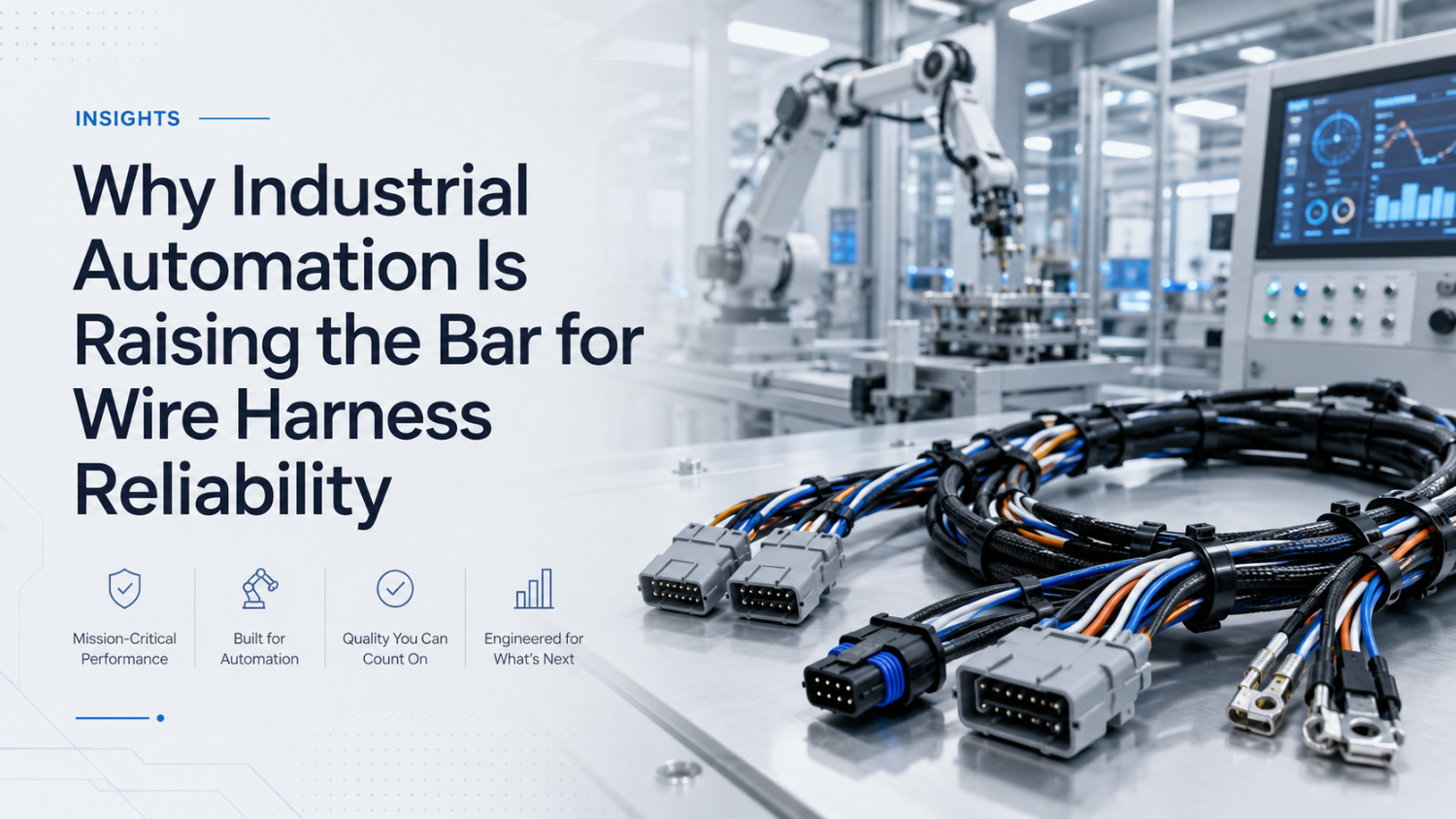
Industrial automation is expanding in both scale and complexity. According to the International Federation of Robotics, factories installed about 542,000 industrial robots in 2024, more than twice the number installed ten years earlier. As automated equipment becomes faster, more connected, and more compact, the wire harnesses inside it face operating conditions that differ sharply from those in simple, mostly static machinery.
A wire harness may appear to be a passive bundle of conductors, connectors, terminals, and protective materials. In an automated system, however, it can link controllers, servo motors, sensors, safety devices, operator panels, valves, and industrial networks. A weak termination, unsuitable cable, or poorly supported branch can therefore cause intermittent faults, unexpected stops, or communication errors. Automation is consequently raising expectations for harness reliability throughout the product lifecycle.
Automation Creates More Demanding Mechanical Loads
Traditional equipment may contain wiring that remains nearly stationary throughout its service life. Automated machinery often introduces repeated bending, vibration, acceleration, and torsion. Robot arms, linear axes, pick-and-place units, CNC equipment, and moving tool heads may cycle thousands of times during a production shift.
These conditions make conductor construction, bend radius, routing, strain relief, and connector retention critical. A harness designed for a static cabinet should not automatically be considered suitable for a cable carrier or articulated robot. Repeated motion can fatigue conductors, abrade insulation, loosen unsupported connections, or transfer stress into a termination.
Reliability therefore begins with a realistic motion profile. Engineers should define whether the harness will be fixed, flexing, torsional, or vibration-prone; identify the minimum bend radius; estimate cycle frequency; and specify clamping points. Sleeving, conduit, overmolding, grommets, and branch supports should be selected for the actual installation rather than added as generic accessories.
Signal Integrity Is Becoming a Harness-Level Requirement
Automation systems increasingly combine high-current motor circuits with low-voltage sensor, encoder, communication, and control signals. Variable-frequency drives and servo amplifiers can generate electrical noise, while industrial Ethernet and high-resolution feedback devices depend on stable signal transmission.
Conductor gauge and current capacity are therefore no longer sufficient design criteria. Shield coverage and termination, pair twisting, grounding, connector compatibility, separation between power and signal conductors, and cable routing may all affect system performance.
The correct solution is application-specific. Designers should evaluate the complete electrical environment, including drive type, switching frequency, cable length, network protocol, grounding architecture, and nearby noise sources. IEC 60204-1 provides a widely used framework for the electrical equipment of machines, while network organizations and equipment suppliers often publish additional installation guidance.
Reliability Now Affects Safety and Uptime
Automated lines are designed to operate with limited manual intervention. When a harness fault occurs, the result may not be a simple loss of power. A damaged sensor circuit can produce inconsistent feedback, a loose connector can trigger repeated alarms, and an intermittent safety-channel connection may force the machine into a protective stop.
Wire harnesses do not create functional safety by themselves, but they form part of the physical path used by emergency stops, interlocks, light curtains, safety controllers, and other protective functions. ISO 10218-1 and ISO 10218-2:2025 reflect the wider need for systematic risk reduction in industrial robot systems and applications.
Intermittent wiring faults are difficult to reproduce and may consume more troubleshooting time than a complete failure. Harnesses that are clearly labeled, logically branched, properly keyed, and accessible for inspection can shorten maintenance work and reduce reconnection errors.
Manufacturing Consistency Matters as Much as Material Selection
Premium wire and connectors cannot compensate for unstable assembly processes. Many harness failures originate at interfaces: under-crimped or over-crimped terminals, incomplete terminal insertion, damaged insulation, incorrect strip length, poor soldering, missing seals, or inadequate strain relief.
IPC/WHMA-A-620F describes materials, methods, tests, and acceptance criteria for cable and wire harness assemblies. Its process-oriented approach is relevant to automation because repeatability is essential when the same machine platform is built in multiple units. Depending on the application, quality controls may include crimp-height monitoring, pull-force testing, continuity testing, pin-to-pin verification, visual inspection, and signal testing.
Traceability is equally important. UL Solutions’ Wiring Harness Traceability Program follows eligible wire and cable from the original manufacturer through the harness producer and into final assembly. For OEMs using external suppliers, such traceability can reduce the risk of undocumented substitutions and simplify compliance management.
| Design Input to Define | Why It Matters |
|---|---|
| Voltage, current, and temperature | Determines conductor size, insulation, and derating |
| Motion type and expected cycles | Influences construction, bend radius, and strain relief |
| Signal or network requirements | Affects twisting, shielding, impedance, and connectors |
| Oil, chemicals, moisture, or abrasion | Guides jacket, sealing, and protection choices |
| Inspection and test requirements | Establishes measurable acceptance criteria |
Design for Assembly, Diagnostics, and Future Changes
Automation projects rarely remain unchanged. Machine builders may add sensors, revise control panels, localize equipment for another market, or adopt a new servo or network architecture. A well-designed harness should support these changes without creating unnecessary complexity.
Modular branches, standardized connector families, clear identification, controlled drawings, and revision tracking can make upgrades more manageable. Keyed connectors, color identification, terminal-position locks, and defined routing points also reduce assembly mistakes. The goal is an interconnection system that can be installed, diagnosed, replaced, and reproduced consistently.
Frequently Asked Questions
1. What makes an automation harness different from a general-purpose harness?
It may need to withstand repetitive motion, vibration, electrical noise, higher connector density, and demanding maintenance schedules. Requirements depend on the machine and installation.
2. Does every moving harness require continuous-flex cable?
No. Repeated bending in a cable carrier, torsion on a robot axis, and occasional maintenance movement create different stresses. Cable construction should match the actual motion.
3. Why are crimp connections so important?
A crimp is the mechanical and electrical interface between the conductor and terminal. Incorrect tooling, dimensions, wire preparation, or process control can increase resistance or reduce strength.
4. Can shielding eliminate all communication problems?
No. Grounding, routing, conductor separation, connector construction, cable length, and network installation practices must also be considered.
5. What tests should be specified for a custom harness?
Common requirements include continuity, pin-to-pin verification, short-circuit testing, visual inspection, pull-force testing, and application-specific signal or dielectric tests. The test plan should be agreed before sampling.
6. How can harness design reduce machine downtime?
Clear labels, accessible connectors, modular sections, stable routing, correct strain relief, and accurate documentation make faults easier to locate and components easier to replace.
Conclusion
Industrial automation is turning the wire harness from a basic assembly item into a reliability-critical subsystem. More motion, denser electronics, faster communications, and stricter safety expectations mean that harness performance must be engineered around the complete machine environment. Reliable results depend on clear specifications, suitable materials, controlled termination processes, meaningful inspection, and traceable production.
For machine builders and equipment developers evaluating custom interconnections for control panels, servo systems, automation equipment, and industrial robots, explore Chan Ming’s industrial wire harness and cable assembly capabilities to review application options and discuss project-specific requirements.