Apr 04, 2026
Technical Analysis of Lightweight PET Preform Design in Modern Bottling Lines
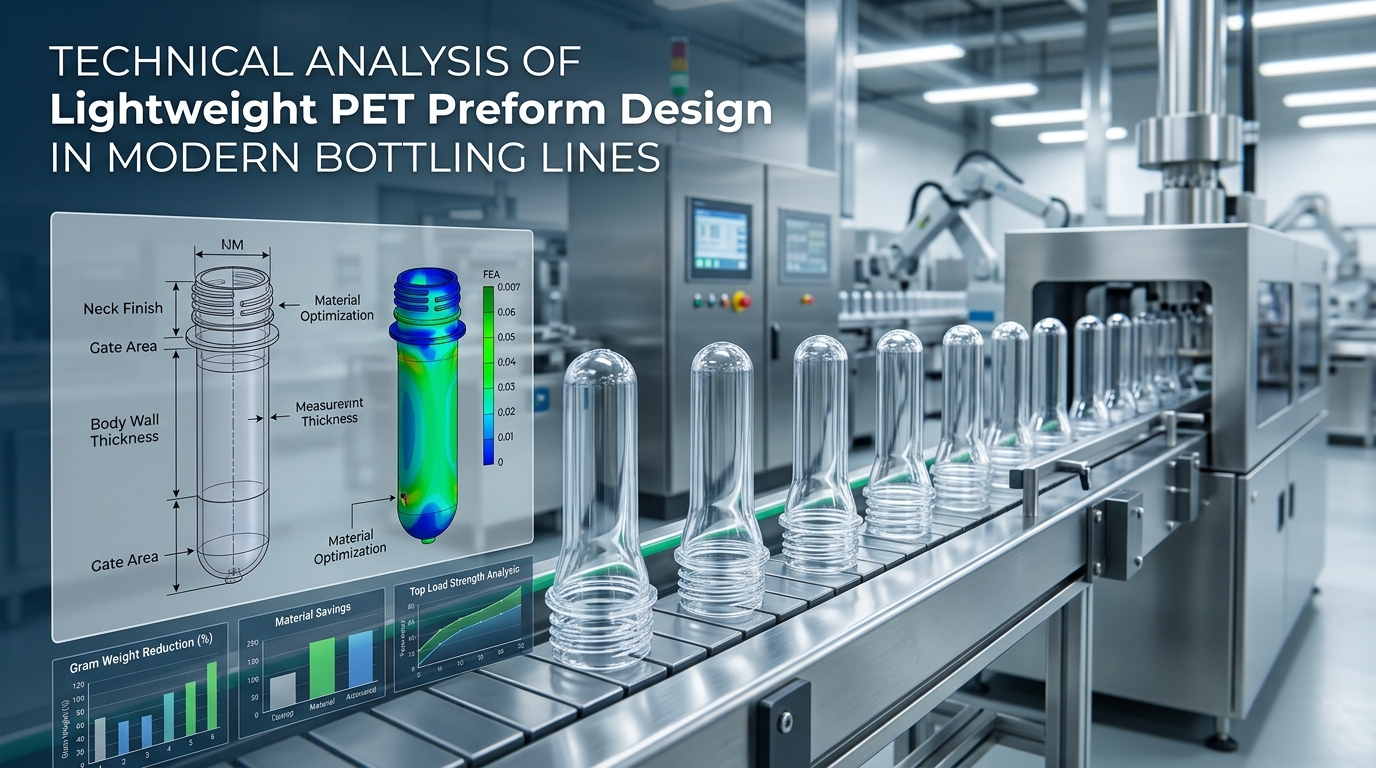
The global beverage industry continues to navigate the complex intersection of structural integrity and material efficiency. In the high-speed environment of modern bottling, the PET preform is no longer viewed as a mere commodity but as a critical engineering component that dictates the efficiency of the entire downstream production cycle. This analysis examines the technical parameters of lightweighting and its implications for Overall Equipment Effectiveness (OEE).
Polymer Distribution and Axial Stretch Ratios
The primary challenge in lightweighting is the maintenance of the hoop stress and axial orientation during the Stretch Blow Molding (SBM) process. Engineering a high-performance preform requires precise control over the resin distribution, particularly in the transition zone between the neck finish and the body.
A technical optimization involves calculating the optimal stretch ratio—typically ranging from 10 to 16 for PET—to ensure that the polymer chains are sufficiently bi-axially oriented. Proper orientation is the fundamental mechanism that provides the final container with its "creep resistance" and clarity. If the preform design is suboptimal, the resulting bottle may exhibit "pearly" (over-stretched) or "hazy" (under-stretched) sections, both of which lead to structural failure under internal carbonation pressure.
Thermal Profiling and Reheat Efficiency
Efficiency in the bottling line is heavily dependent on the reheat characteristics of the preform. Modern infrared (IR) heating ovens require preforms with consistent wall thickness and specific IV (Intrinsic Viscosity) values.
- Thermal Absorption: Variations in colorants or the inclusion of reheat additives must be strictly managed to ensure a uniform temperature gradient across the preform wall.
- Dimensional Stability: The neck finish must remain below the glass transition temperature ($T_g$) during the reheating phase to prevent thread deformation. This is achieved through precision-molded cooling rings that interface with the oven's mandrels.
When dimensions are held to a tolerance of $\pm 0.1$ mm, the unscrambler and transfer starwheels can operate at maximum RPMs without triggering torque-limit stops, which is a primary cause of unplanned downtime in B2B beverage manufacturing.
Interface Integrity: The PCO 1881 and 1810 Standards
For food safety and carbonation retention, the interface between the preform neck and the closure is paramount. Technical focus has shifted towards the PCO 1881 short-neck standard, which reduces resin weight by approximately 2 grams per unit compared to the older 1810 standard.
However, this reduction introduces a narrower "sealing land." Achieving a gas-tight seal requires the injection molder to eliminate any "flash" or "gate scars" on the sealing surface. In B2B procurement, the focus remains on the Ovality of the neck finish; even a minor deviation can lead to "leakers" in the warehouse, compromising the brand's supply chain integrity and increasing the risk of microbial contamination.
Material Evolution: Incorporating rPET and PCR
As regulatory frameworks like the EU's Plastic Packaging and Packaging Waste Regulation (PPWR) tighten, the integration of Post-Consumer Resin (rPET) into preform production has become a technical necessity.
The challenge lies in the variable IV levels and higher moisture content of recycled feedstocks. A sophisticated preform manufacturing process must utilize advanced filtration systems (up to 40 microns) and vacuum-degassing extruders to ensure that the rPET-integrated preforms match the mechanical performance of virgin resin. This ensures that the transition to sustainable packaging does not result in a higher "burst rate" during the high-pressure (up to 40 bar) blowing process.
Professional Packaging Solutions
The technical optimization of PET packaging requires a partner with deep expertise in injection molding and precision mold design. Living Fountain provides a comprehensive range of PET preforms, bottle caps, and dispensing pumps engineered to meet the rigorous tolerances of the food and beverage industry. For organizations seeking to enhance packaging efficiency or integrate recycled materials into their production, further technical specifications and custom development options are available on the Living Fountain official website.