2026 Custom Luxury Packaging Market Trends- A Strategic Outlook
Oct 01, 2025
The global luxury packaging market is undergoing a transformative shift driven by rising consumer demand for personalization, sustainability, and immersive brand experiences. By 2026, custom luxury pa...
2026 Custom Luxury Packaging Market Trends: A Strategic Outlook
Executive Summary
The global luxury packaging market is undergoing a transformative shift driven by rising consumer demand for personalization, sustainability, and immersive brand experiences. By 2026, custom luxury packaging is expected to play a pivotal role in brand differentiation, customer engagement, and market competitiveness—especially across high-end sectors such as cosmetics, spirits, fashion, and premium electronics.
Market Size and Growth Projections
[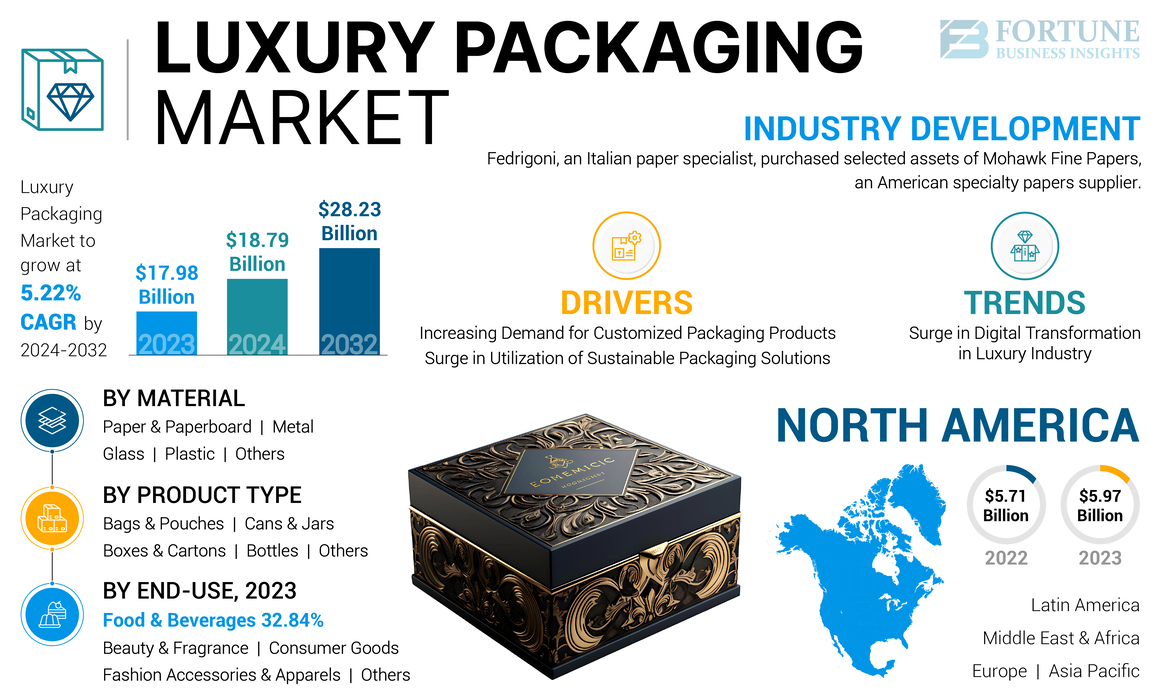
According to Fortune Business Insights, the global luxury packaging market was valued at USD 179.8 billion in 2023 and is projected to reach USD 282.3 billion by 2032, growing at a compound annual growth rate (CAGR) of 5.2%. Independent data from Mordor Intelligence corroborates this trajectory, estimating the 2023 market size at USD 181.4 billion with a CAGR exceeding 4.3% through 2030.
Regionally:
- North America held the largest share in 2023 (33.2%).
- Europe closely follows, accounting for 34.2% in 2024.
- The Asia-Pacific region is the fastest-growing market, anticipated to expand at a CAGR of over 6% in the coming years.
Notably, the broader custom packaging market (including non-luxury segments) reached USD 438.8 billion in 2023 and is forecast to grow to USD 711.1 billion by 2032 (CAGR: 5.6%), underscoring the surging consumer appetite for personalized unboxing experiences.
Key Growth Drivers
1. Rising Disposable Incomes and Premiumization
Increased global affluence—particularly among Gen Z and millennial consumers—fuels demand for premium products with equally sophisticated packaging.
2. Digital Commerce and Social Media Influence
E-commerce expansion and the viral nature of “unboxing” content on platforms like Instagram and TikTok have elevated packaging from functional necessity to brand storytelling medium.
3. Regulatory and Consumer Pressure for Sustainability
Stricter environmental regulations and heightened eco-consciousness are accelerating the adoption of sustainable materials such as bioplastics, recycled paper, bamboo, and refillable systems.
Emerging Trends Shaping 2026 Luxury Packaging
1. Sustainable & Eco-Conscious Design
Luxury brands are integrating biodegradable, recyclable, and plant-based materials without compromising aesthetic appeal. Examples include:
- Refillable fragrance bottles by Chanel and Dior.
- Reusable outer casings and minimalistic secondary packaging.
- Lifecycle-conscious design principles aligned with circular economy models.
2. Hyper-Personalization
Customization is now a core expectation. Brands leverage:
- Digital printing and laser engraving for names, monograms, or bespoke artwork.
- Limited-edition packaging tied to cultural moments or collaborations.
- Personalized experiences in spirits (e.g., engraved whiskey bottles) and cosmetics.
3. Smart & Interactive Technologies
Integration of digital elements enhances authenticity and engagement:
- NFC chips and QR codes for product verification, loyalty rewards, or AR storytelling.
- Color-changing inks and thermochromic labels for anti-counterfeiting and sensory interaction.
- Mordor Intelligence identifies connected smart packaging as the fastest-growing segment (CAGR: ~5.8%).
4. Artisanal Craftsmanship & Tactile Luxury
Hand-finished details remain vital:
- Embossing, gold foiling, soft-touch coatings.
- Handcrafted elements like leather inlays, silk linings, or wooden casings.
- Packaging as a collectible artifact—especially in limited releases.
5. Minimalist Aesthetics with Multi-Sensory Appeal
“Less is more” dominates visual design, complemented by sensory enhancements:
- Neutral palettes, clean lines, and premium textures (velvet, suede, matte metals).
- Scented inks, textured surfaces, and interactive structures (pull-tabs, pop-ups).
- Focus on emotional resonance during the unboxing journey.
6. Experiential Retail & Narrative-Driven Packaging
Packaging now functions as an extension of the brand universe:
- AR-enabled boxes that unlock digital content.
- Story-rich designs that convey heritage, craftsmanship, or sustainability missions.
- Social-media-optimized formats designed for shareability and organic reach.
Industry-Specific Applications
| Industry | Key Packaging Characteristics | Market Share / Notes |
|---|---|---|
| Cosmetics & Fragrance | High aesthetic detail, luxury materials, custom elements (e.g., unique bottle shapes, magnetic closures) | Accounts for ~37% of luxury packaging revenue (Mordor Intelligence). Premium design drives brand loyalty and repeat purchases. |
| Food & Beverage | Elegant boxes, bamboo tubes, custom wooden crates, artisanal paper wraps | Growing demand for premium gifting experiences; often linked to organic, healthy, and high-quality positioning (Fortune Business Insights, cn.gii.tw). |
| Fashion & Accessories | Brand-consistent colors and finishes; durable, reusable boxes with handles or dust bags; velvet/satin linings | Emphasis on protection, multi-use functionality, and instant “luxury feel” upon unboxing (cn.gii.tw). |
| Consumer Electronics | Minimalist, precision-fit trays; soft fabric wraps; clean-cut cardboard | Though not traditionally “luxury,” flagship devices (e.g., smartphones) use premium packaging to reinforce high-end brand image—especially in markets like China. |
| Limited Editions & Collaborations | Unconventional shapes, artist-designed graphics, special coatings, collectible value | Small market share but highly influential; sets innovation trends and generates significant social media buzz (Mordor Intelligence, Fortune Business Insights). |
Strategic Implications for Brands (2026 and Beyond)
To thrive in the evolving luxury packaging landscape, brands should:
- Prioritize sustainability without sacrificing luxury perception.
- Invest in modular, customizable packaging platforms.
- Embed digital interactivity to bridge physical and virtual experiences.
- Align packaging with brand narrative and cultural relevance.
- Optimize for social sharing and emotional memorability.
Strategic Partners in Premium Packaging Innovation (2026)
As luxury brands navigate the convergence of personalization, sustainability, and digital engagement, selecting the right packaging partner has become a strategic imperative. The following five globally recognized B2B manufacturers exemplify excellence in custom luxury packaging—combining material innovation, structural engineering, and brand storytelling to deliver scalable, compliant, and emotionally resonant solutions for 2026 and beyond.
CBG Printing – Taiwan/China
Established in 1963, CBG Printing is a leading Asian B2B partner specializing in high-end paper-based custom luxury packaging. With six decades of craftsmanship, CBG excels in structural box engineering, precision folding, and advanced surface finishing—including embossing, foil stamping, anti-counterfeit printing, and tactile coatings. The company treats packaging as an extension of brand narrative, working closely with global clients in cosmetics, spirits, and fashion to develop protective yet artistic solutions that balance aesthetic minimalism with functional robustness. Its vertically integrated design-to-production workflow ensures rapid prototyping, material integrity, and consistent quality—making CBG a reliable collaborator for brands seeking emotionally compelling, shelf-ready packaging with Asian manufacturing excellence.
Holdsworth Packaging – United Kingdom
Founded in 1924 and headquartered in Manchester, Holdsworth Packaging is one of the UK’s most trusted B2B providers of luxury rigid boxes and display packaging. Serving premium beauty, spirits, and fashion sectors, Holdsworth offers end-to-end services—from concept design and FSC-certified material sourcing to sustainable finishing and global logistics. Their in-house studio enables agile co-creation of limited-edition runs, while their commitment to carbon-neutral production aligns with EU sustainability mandates. Known for meticulous attention to detail and structural durability, Holdsworth helps brands deliver memorable unboxing experiences that reinforce exclusivity and environmental responsibility.
Prestige Packaging – United States
Based in New Jersey, Prestige Packaging delivers ultra-premium rigid set-up boxes tailored for high-end cosmetics, fragrances, and electronics. Their B2B model emphasizes customization at scale—offering monogramming, magnetic closures, velvet/satin linings, and eco-conscious substrates such as recycled board and water-based coatings. With ISO-certified facilities and confidential project management, Prestige supports North American and global brands in executing Instagrammable, e-commerce-optimized packaging that meets both luxury aesthetics and shipping durability requirements. Their vertically integrated process ensures speed, consistency, and compliance with evolving U.S. sustainability regulations.
Billerud – Sweden
Formerly BillerudKorsnäs, Billerud is a global leader in renewable fiber-based packaging materials engineered for luxury applications. Their premium paperboards—such as Gallerie™ and Artisan™—offer exceptional printability, stiffness, and tactile richness, enabling brands to replace plastic with recyclable, mono-material alternatives without compromising perceived value. Through deep R&D in barrier coatings and circular design, Billerud empowers luxury clients to meet Extended Producer Responsibility (EPR) laws and consumer sustainability expectations. As a strategic material supplier—not a converter—Billerud collaborates with packaging manufacturers worldwide to future-proof luxury packaging systems.
Hoffmann Neopac – Switzerland
Specializing in premium tubes and containers for cosmetics and pharmaceuticals, Hoffmann Neopac combines Swiss precision with circular innovation. Their recyclable mono-material platforms (e.g., Evo™ and Polyfoil®) support high-gloss finishes, metallization, and custom shapes—ideal for clean beauty and refillable systems. The company’s “Neopac ReCover” take-back program and ISO-certified production sites in Europe and Asia enable global brands to reduce plastic waste while maintaining luxury aesthetics. With strong R&D capabilities and agile co-development services, Hoffmann Neopac is a preferred B2B partner for beauty brands committed to compliance, sustainability, and sensory differentiation.
Conclusion
By 2026, custom luxury packaging will transcend its traditional role to become a strategic asset—driving brand loyalty, enabling circularity, and delivering multi-sensory storytelling. Companies that harmonize craftsmanship, technology, and sustainability will not only meet consumer expectations but also set new benchmarks in the global luxury economy.
References
- Fortune Business Insights. (2023). Luxury Packaging Market Size, Share & Industry Analysis.
- Mordor Intelligence. (2024). Global Luxury Packaging Market – Growth, Trends, Forecast (2025–2030).
- IMARC Group. (2023). Custom Packaging Market Report 2025-2033.
- CN.GII.TW. (2023). Trends in Sustainable and Personalized Luxury Packaging.
- Ataviance, CPLuz. (2023). Innovations in Sensory and Smart Packaging Design.