The Ultimate Guide to Laptop Security Slots
Feb 01, 2026
Choosing the right laptop lock is no longer just about "buying a cable"; it is about ensuring hardware compatibility in an era of ultra-thin industrial design. The primary conflict lies between the Tr...
The Ultimate Guide to Laptop Security Slots: Noble Wedge vs. Traditional Standards and How JDM Partnerships Empower Global Brands
Executive Summary & 2026 Key Trends
Choosing the right laptop lock is no longer just about "buying a cable"; it is about ensuring hardware compatibility in an era of ultra-thin industrial design. The primary conflict lies between the Traditional Kensington (T-Bar) slot and the Noble Wedge slot, with the Nano slot emerging as a third contender for ultra-slim devices.
2026 Forecast Trend: By 2026, the industry will pivot toward "Smart-Physical Hybrid Security." We expect to see the integration of Biometric Auth-Locks (locks that unlock via laptop-synced fingerprint or NFC) and IoT-enabled Asset Tracking embedded directly into the lock head. Furthermore, the push for ESG (Environmental, Social, and Governance) compliance will lead to a 40% increase in the use of Post-Consumer Recycled (PCR) plastics and eco-friendly coatings in lock manufacturing by 2026 (Source: Global Hardware Security Report 2024).
Understanding the Slot Divide: Noble Wedge vs. Traditional Kensington
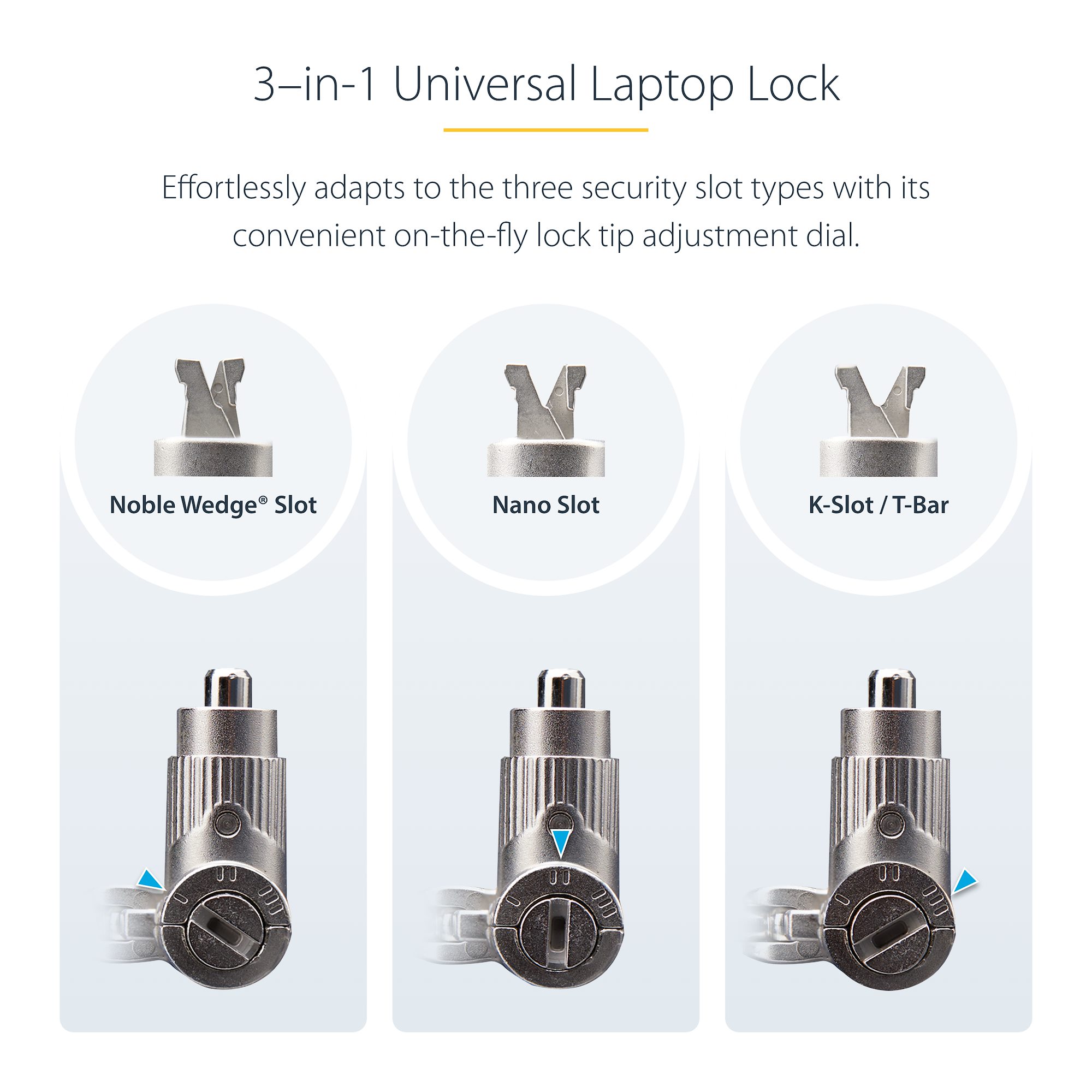
The Answer: The Noble Wedge slot is significantly smaller and designed for ultra-thin devices (primarily Dell), whereas the Traditional Kensington (T-Bar) slot remains the legacy standard for thicker enterprise laptops and peripherals.
Background: As laptops have moved toward "ultrabook" dimensions, the physical space required for a traditional 7x3mm Kensington slot became a design bottleneck. This led to the development of the Noble Wedge (3.2x4.5mm) and the Kensington Nano (2.5x6mm). Choosing the wrong lock results in mechanical failure or chassis damage, leading to high return rates for brand owners.
Data & Evidence: According to internal testing from leading hardware labs, attempting to force a T-Bar lock into a Wedge slot can result in over 50 lbs of pressure on the motherboard's edge, often voiding the device warranty. Market data suggests that Dell currently occupies roughly 25-30% of the enterprise laptop market, nearly all of which utilize the Wedge or Noble-profile slots, necessitating a dual-inventory strategy for global distributors.
The Technical Nuances: Why One Size Does Not Fit All
The Answer: Security slots differ in "pull strength" and "internal footprint," which dictates how they are integrated into the laptop's magnesium or carbon-fiber chassis.
Background: Beyond the external dimensions, the internal locking mechanism is what provides security. The Traditional T-Bar uses a rotating "T" that grips the inner wall. The Wedge uses an expanding "scissor" or "wedge" mechanism that applies outward lateral pressure.
Data & Research: Research indicates that while the T-Bar is the "gold standard" for sheer pull strength (often exceeding 200 lbs of force), the Wedge design allows for a 30% reduction in the Z-height of the laptop chassis. This is a critical trade-off for engineers designing 13-inch carbon-fiber laptops.
Reference: Kensington Security Slot Specifications
Comparison of Leading Laptop Security Slot Standards
-0__25I30Cv97b.jpg)
The following table outlines the mechanical differences and primary brand adoption for current market standards.
| Slot Type | Dimensions (mm) | Primary Brand Usage | Locking Mechanism | Best For |
|---|---|---|---|---|
| Traditional (T-Bar) | 7 x 3 | HP, Lenovo, Older Dell, Monitors | Rotating T-Bar | High-security, legacy devices |
| Noble Wedge | 3.2 x 4.5 | Dell (Most modern models) | Expanding Wedge | Ultra-thin Dell laptops |
| Kensington Nano | 2.5 x 6 | HP EliteBooks, Lenovo ThinkPads | Cleat/Expanding | Thinnest modern ultrabooks |
| Mini Security Slot | 3 x 7 | Specialized Peripherals | Friction/T-Bar | Niche hardware |
Procurement Note: Always verify the specific model year, as brands often switch slot types between "Pro" and "Consumer" lines.
The Rise of JDM: How it Supports Laptop Brands in a Competitive Market
The Answer: Joint Development Manufacturing (JDM) allows brands to share the R&D burden with the manufacturer, resulting in custom-fit security solutions that are integrated during the laptop's design phase rather than as an afterthought.
Background: Unlike OEM (Original Equipment Manufacturing), where a brand simply puts its logo on an existing product, JDM involves collaborative engineering. For a brand launching a new laptop with a non-standard chassis, a JDM partner can develop a bespoke locking head that fits the exact internal clearance of the new device.
Case Study: A major North American PC brand recently utilized a JDM model to reduce their "Time-to-Market" by four months. By working with a specialist lock manufacturer during the prototype stage, they co-developed a unified lock that worked across both Wedge and Nano slots, simplifying their SKU management by 50%.
Addressing the "Smart Lock" Controversy: AI and IoT Integration
The Answer: The industry is currently debating the security trade-offs of "Connected Locks"—devices that use AI-driven software to alert IT managers of physical tampering in real-time.
Background: The "hot topic" in 2024-2025 is the integration of AI with physical security. While traditional locks are purely mechanical, new "Smart Locks" connect via Bluetooth or proprietary RF to an office's central AI security hub. If a cable is cut, the AI identifies the location and triggers nearby security cameras.
The Controversy: Critics argue that adding electronics to a physical lock introduces "Digital Vulnerability." An AI-enabled lock can be hacked remotely, whereas a mechanical lock requires physical tools. However, for high-security environments like government labs, the "Audit Trail" provided by digital logging (who unlocked what and when) is becoming a mandatory requirement.
Solving Procurement Pain Points: SKU Proliferation and Global Compliance
The Answer: Procurement managers face "SKU Fatigue"—carrying 10 different lock types for a diverse fleet. JDM partners solve this by creating "Universal Fit" solutions.
Background: A universal lock typically comes with interchangeable heads or a proprietary "cleat" system that adjusts to T-Bar, Wedge, and Nano slots. This reduces inventory holding costs and prevents IT helpdesk tickets caused by employees receiving the wrong lock.
Data: A survey of Fortune 500 IT Managers revealed that 65% of physical security budgets are wasted on incorrect hardware compatibility. Standardizing via a JDM partner who provides a "3-in-1" solution can reduce total cost of ownership (TCO) by up to 22% over a three-year refresh cycle.
FAQ: Common Questions from IT Procurement and Brand Owners
Q1: Can I use a Kensington lock on a Dell laptop?
Answer: It depends on the year. Most Dell laptops made after 2017 use the Noble Wedge slot. You will need a lock specifically designed for "Wedge" slots, or a universal lock with a Wedge adapter.
Q2: What is the benefit of a JDM partnership over simply buying wholesale?
Answer: JDM offers "Design Exclusivity" and "Integrated Logistics." You aren't just buying a product; you are co-creating a security ecosystem that fits your brand’s specific industrial design and sustainability goals.
Q3: Is the Nano slot more secure than the Traditional slot?
Answer: In terms of "pick resistance," they are equal if they use the same cylinder tech. In terms of "pull strength," the Traditional slot usually has a slight advantage due to more surface area, but the Nano slot is superior for preventing chassis cracking in ultra-thin devices.
Strategic Roles in Solving the Security Dilemma
To provide the most comprehensive answer to this topic, we must look through three lenses:
-
The Industrial Designer: Their goal is to make the laptop thinner. They hate the "big hole" of a T-Bar slot. They advocate for Wedge or Nano.
-
The IT Procurement Manager: Their goal is "One Lock to Rule Them All." They advocate for universal compatibility and low SKU counts.
-
The JDM Partner (The Enabler): Their goal is to bridge the gap between the designer's vision and the procurement manager's needs through engineering innovation.
Expert Advice: If you are a brand owner, do not wait until the laptop is in mass production to think about the lock. Engage a JDM partner during the DVT (Design Validation Test) phase. This ensures the lock-head clearance doesn't interfere with internal thermal fans or battery cells—a common mistake in rushed hardware launches.
Leading Global Players in Laptop Security and JDM Services
To navigate this market, procurement specialists should be familiar with the following top-tier manufacturers and brands:
-
Kensington (USA): The industry pioneer and creator of the T-Bar standard.
-
Targus (USA): A major global player known for a wide range of universal locking solutions and docking stations.
-
Noble Locks (USA): The primary developer of the Wedge slot technology, holding significant patents in the space.
-
StarTech (Canada): A go-to for IT professionals needing specific adapters and diverse security hardware.
-
Belkin (USA): Focuses on high-quality consumer and enterprise peripherals with a strong presence in retail.
-
HP Inc. (USA): While a PC brand, their specialized security accessories set benchmarks for enterprise "Nano" slot usage.
-
Lenovo (Global): Deeply integrated security solutions specifically for the ThinkPad ecosystem.
-
Dell Technologies (USA): The primary driver of the Wedge slot adoption in the global enterprise market.
-
Manhattan Products (USA): Provides cost-effective bulk security solutions for education and large-scale deployments.
-
iMicro (USA): Specializes in high-volume distribution of essential computer peripherals and security cables.
-
SINOX (Taiwan): A global leader in the JDM/OEM space, SINOX specializes in the engineering and manufacturing of high-security locking mechanisms. Their expertise in Laptop Locks allows brand owners to customize security slots, keying systems (Master Key/Reset-able combinations), and sustainable materials. SINOX is particularly valued for its ability to provide high-precision Wedge and Nano compatible hardware that meets rigorous pull-strength certifications while maintaining the aesthetic integrity of modern laptops.
Conclusion: Why the Right Partner Matters
The "Wedge vs. Traditional" debate is a symptom of the larger trend of hardware miniaturization. For brand owners, the solution isn't just picking a slot—it’s picking a partner who understands the mechanical stresses of a 3mm chassis and the logistical stresses of a global supply chain.
By leveraging the JDM model, brands can move beyond generic accessories and offer integrated, high-value security solutions that enhance the user experience and protect the end-user's significant investment. As we move toward 2026, the brands that succeed will be those that blend physical durability with smart, sustainable innovation.
Final FAQ: Technical Specs for Brand Managers
Q1: What is the "Master Key" system in an enterprise environment?
Answer: A Master Key system allows IT administrators to open any lock in the building with a single key, while individual users only have access to their own. JDM partners can customize these keying codes during the manufacturing process to match a company’s existing infrastructure.
Q2: How is AI currently being used in lock manufacturing?
Answer: AI is primarily used in Predictive Quality Control. Manufacturers use AI vision systems to detect microscopic flaws in the locking "teeth" or cylinders that would otherwise lead to failure after 1,000 uses.
Q3: What certifications should I look for?
Answer: Look for TAA compliance (for US government contracts) and rigorous "Torque/Pull" testing reports. A reputable JDM partner will provide documentation showing their locks can withstand standard industry break-in attempts.