Aug 26, 2026
Youth and Training Compound Bows: Safety-First Design for OEM Distributors
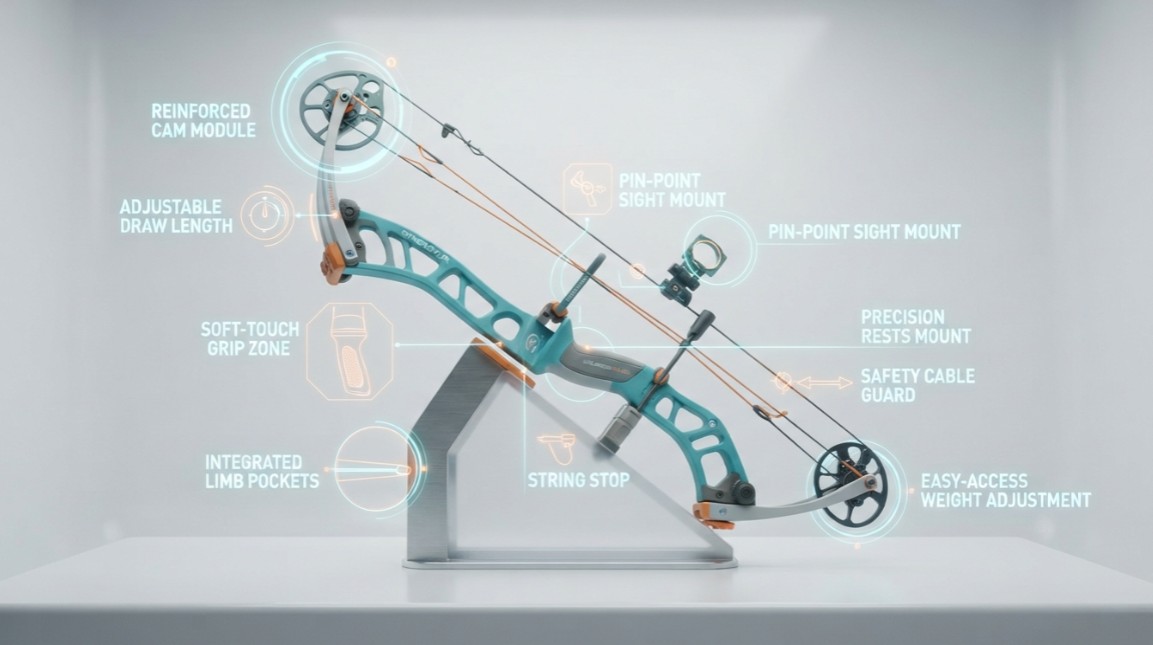
Youth and training compound bows sit in a different risk category than adult hunting equipment, yet many OEM distributors evaluate them with the same checklist: draw weight, speed, and price. That approach misses what actually matters for this segment. A bow built for a first-time 10-year-old archer or a school archery program has to account for inconsistent grip strength, unpredictable release technique, and years of physical growth, all while staying safe enough for supervised but not always expert instruction. Distributors who get this wrong face returned inventory, liability exposure, and program buyers (schools, camps, archery ranges) who will not reorder after a single safety complaint. Before placing an OEM order, it helps to understand what safety-first design actually looks like in this category: appropriate draw weight ranges, the mechanical features that reduce injury risk, how bows accommodate a growing user, and what documentation a supplier should be able to produce on request.
Draw Weight and Sizing: What "Youth-Appropriate" Actually Means
Draw weight is the first filter, and getting the range wrong undermines everything else. General guidance from youth archery retailers puts beginner draw weights in the 10 to 20 lb range, with a broader youth window extending to roughly 30 to 40 lbs as strength and technique improve, and manufacturers such as Bear Archery build entry models around this curve: the Spark is designed around a 10 lb continuous draw weight for the youngest archers, while models aimed at ages 13 and up move closer to 18 lbs continuous. The guiding principle repeated across these sources is that a lighter bow supporting relaxed posture and a repeatable anchor point is a better training tool than a heavier bow that forces shrugging, jerking, or early fatigue, and that draw weight should track physical development and coaching quality rather than age alone.
For OEM distributors, this means a single youth SKU rarely covers the full market. A 12 to 20 lb range suits first-time archers and school programs, while a 19 to 30 lb range suits older youth or small-framed adults transitioning from a training bow to a standard model. Catalogs that list a wide, vague range without documenting where let-off, brace height, and axle-to-axle length sit at each end of that range make it harder to match product to buyer, and harder to defend the fit if a program buyer raises a safety question later.
Safety Mechanisms and Design Features Distributors Should Look For
A few design choices show up repeatedly in bows built specifically for beginners and youth programs, and distributors should be able to point to them in a supplier's spec sheet rather than take marketing copy at face value.
No-let-off or low-let-off cam systems reduce the mechanical complexity of the draw cycle, which lowers the chance of pinched fingers or unpredictable string behavior during a beginner's first few shots. The National Archery in the Schools Program (NASP), one of the largest standardized youth archery programs in the United States, builds its entire curriculum around a single compound bow model with no let-off, adjustable from 11 to 20 lbs of draw weight at any draw length, specifically because standardized, simplified equipment is safer to share across students of different sizes and skill levels. That same logic applies to OEM sourcing: a training bow with fewer adjustable parts and a predictable draw cycle is generally easier to supervise safely in a group setting.
Limb and riser construction also matter. Molded composite or fiberglass limbs paired with a lightweight aluminum or reinforced polymer riser keep stored energy lower and reduce the consequences of user error, such as an incomplete draw or an off-center release, compared with the higher-poundage limb assemblies used in adult hunting bows. Cable guards and containment features that keep the string and cables running in a predictable path reduce the risk of the string contacting a young archer's forearm or face on release, which is one of the more common minor injuries reported in beginner archery settings.
Dry-fire risk deserves specific attention for training bows because they are more likely to be handled by inexperienced users who may draw and release without an arrow nocked. While anti-dry-fire mechanisms are more commonly discussed in crossbow design, the underlying concern (a bow releasing stored energy with nothing to absorb it) applies to compound bows as well, and can damage limbs or, in worse cases, cause the bow to fail near the user's hands or face. Distributors should ask suppliers directly whether a given training model has been tested for dry-fire tolerance or whether instructional materials and packaging carry an explicit warning against it, since not every entry-level compound bow is engineered the same way in this respect.
Adjustability for a Growing User Base
Because youth archers change size and strength over a single season, let alone several years, adjustability is a practical safety feature as much as a value-add. A bow that cannot be adjusted downward in draw weight or draw length tends to get "muscled" by a young user trying to compensate, which is exactly the shrugging and poor-form behavior that increases injury risk and undermines skill development. Programs and family buyers both favor models that can be dialed back for a smaller or newer archer and adjusted up as the same user gains strength, extending the useful life of a single unit rather than forcing a replacement purchase every year.
For distributors, this translates into a straightforward sourcing question: does the OEM catalog offer draw weight and draw length adjustment within a single model, or does the supplier expect the distributor to stock multiple fixed-spec SKUs to cover a growth curve? Both approaches can work commercially, but they carry different inventory and customer service implications, and the answer should be confirmed before committing to a purchase order, not discovered after the first round of customer feedback.
What to Verify Before Placing an OEM Order
Marketing language on a spec sheet is not the same as documented performance. Before finalizing an order for youth or training compound bows, distributors should request:
- Draw weight and draw length test data for each model, ideally measured across the stated adjustment range rather than at a single midpoint.
- Material specifications for limbs and risers, including whether limbs are rated for the stated maximum draw weight with a margin of safety, not just at the exact target poundage.
- Any internal or third-party quality testing the factory performs, such as cycle testing on limbs and cams, and how consistently that testing is applied across production batches rather than only on sample units.
- Packaging and instructional materials, since safety warnings around dry-firing, proper draw length fitting, and supervision recommendations are part of the product's real-world safety profile, not an afterthought.
The Archery Trade Association (ATA), the primary U.S. trade body representing archery manufacturers and retailers, maintains a set of technical guidelines built from decades of accumulated engineering practice across the industry, and members use conformity with these guidelines as a credibility signal with dealers and consumers. Distributors sourcing from an OEM factory do not need the factory to be an ATA member to ask a related question: can the supplier explain, in specific terms, how its training bow designs align with widely recognized industry practices on draw weight labeling, limb safety margins, and dry-fire risk, rather than simply asserting the product is "safe for kids."
FAQ
Q: Can one training bow model realistically serve both a 9-year-old and a 14-year-old? A: Generally not without a wide adjustment range or a documented handoff to a second model. A single fixed-spec bow suited to a small 9-year-old is usually too light and too short in draw length for a 14-year-old with more strength and reach, which is why many programs stock two or three tiers rather than one universal SKU.
Q: Do youth compound bows require any specific import certification? A: Requirements vary by destination market and are typically tied to general consumer product safety regulations rather than an archery-specific certification, so distributors should confirm applicable requirements with their own compliance or customs counsel rather than assuming a supplier's export documentation covers every market automatically.
Q: What happens if a distributor defaults to the lowest available draw weight to stay on the safe side? A: It can backfire. A draw weight so low that it cannot properly cycle a cam system or stabilize an arrow in flight creates its own handling problems, including poor arrow flight and a frustrating first experience that discourages a new archer. The better approach is matching draw weight to the specific bow's engineered range and the user's actual strength and coaching level, rather than reflexively picking the lowest number on the spec sheet.
Conclusion
The core decision principle for OEM distributors in this category is straightforward even though the product engineering is not: prioritize documented, testable safety characteristics (draw weight range, limb safety margins, dry-fire tolerance, adjustability) over marketing claims about being "kid-friendly," and confirm those characteristics with real test data before committing to volume. This principle holds regardless of whether the end buyer is a retail parent, an archery range, or a school program, though the acceptable margin for error shrinks considerably for programs where equipment gets shared across many young users with varying skill levels.
What changes the calculus is the buyer type and market. A distributor serving individual retail customers has more room to offer a range of fixed-spec models at different price points, while one serving schools or camps should weight adjustability and standardization more heavily, following the same logic NASP applies at the program level. Either way, the next step before ordering is the same: request the supplier's actual test documentation and sample units, verify draw weight and dry-fire behavior independently rather than relying on the catalog description, and confirm that quality testing is applied consistently across production runs, not just on the units used for marketing photos.
Man Kung's archery bow lineup includes the Besra (MK-CBK1), described on its own product page as a starter compound bow package for young archers, with a draw weight range of 19 to 25 lbs, a draw length of 19 to 20.5 inches, and a carrying case included in the package, alongside lighter options such as the 12 lb draw weight MK-CB015 for earlier-stage beginners. Distributors evaluating training-tier compound bows can review the full specifications at mankungcrossbows.com.