May 19, 2026
Why OEM/ODM Buyers Are Turning to Custom CNC-Machined Slot Car Hubs from Taiwan
The Hidden Complexity Behind a Simple-Looking Hub

At first glance, a slot car hub seems like a trivially simple component — a small disc of metal with a hole through the middle. But ask anyone who has tried to source them at scale, and a different story emerges.
Tolerances matter enormously. A hub that's even 0.1 mm out of round throws off wheel balance, introduces vibration at high RPM, and ruins the handling characteristics that serious builders and brands spend months fine-tuning. When you're producing hundreds or thousands of units for a product line, inconsistency isn't just inconvenient — it's a brand problem.
This is exactly why more slot car brands and hobbyist product companies are moving away from generic off-the-shelf hubs and toward custom CNC turning — working directly with OEM/ODM manufacturing partners who can machine each hub to precise, repeatable specifications at scale.
What OEM/ODM Actually Means in This Context
In the slot car hub market, the distinction between OEM and ODM matters:
- OEM (Original Equipment Manufacturer): The buyer provides drawings and specifications; the manufacturer produces to those exact specs. This works well for brands that have already developed their own hub geometry and want consistent production at volume.
- ODM (Original Design Manufacturer): The manufacturer contributes engineering and design expertise alongside production. This is increasingly popular with startups and mid-sized brands that want a custom-looking, performance-tuned hub without the overhead of an in-house engineering team.
Taiwan-based CNC workshops — particularly those equipped with Swiss-type and multi-axis lathes — have become a preferred source for both models, owing to a combination of machining precision, material expertise, and relatively fast iteration cycles compared to larger-volume markets.
One example is DMS Group (Direct Manufacture Supplier International Inc.), a Taichung-based precision machining supplier that handles both OEM and ODM engagements for slot car hub clients. Their model — supporting buyers from initial DFM review through full production — reflects how the better Taiwan CNC shops have positioned themselves: not just as fabricators, but as manufacturing partners across the product development cycle.
Material Selection: Where Performance Customization Starts
For a slot car hub, the choice of material is one of the most consequential design decisions — and it's an area where experienced OEM/ODM partners add real value.
7075 Aluminum
The workhorse choice. High strength-to-weight ratio, excellent machinability, and broadly compatible with anodizing for color customization. Well-suited for production runs where consistency and cost efficiency are priorities.
Brass
Heavier than aluminum, which can actually be an advantage in specific 1/32 or 1/24 scale applications where added rotational mass helps smooth out power delivery. Brass also machines to very fine surface finishes and has long been a favorite in the traditional slot car community.
Magnesium Alloy (e.g., AZ63A)
The most performance-oriented option and the one generating the most interest among serious builders. Magnesium alloy is approximately 35% lighter than aluminum — a meaningful difference in a component defined by rotational mass. The reduction in unsprung, rotating weight translates directly to faster acceleration response and reduced vibration at speed.
The tradeoff: magnesium requires additional post-machining treatment (typically hard coating or anti-corrosion finishing) to ensure durability. This is where choosing a manufacturer experienced specifically with magnesium becomes important — the machining and finishing processes differ significantly from aluminum, and shortcuts show up quickly in field performance.
DMS Group, for instance, applies specialized hard coating and anti-corrosion surface treatment to their magnesium hub production as a standard step — not an optional add-on — reflecting the kind of material-specific process discipline that separates capable suppliers from generalist shops.
The CNC Turning Process: What Buyers Should Expect
Understanding the manufacturing process helps OEM/ODM buyers ask better questions and set realistic expectations for lead times, tolerances, and finishing options.
Step 1 — Design Review & DFM Feedback
A capable OEM/ODM partner doesn't just accept drawings and start cutting. Design for Manufacturability (DFM) review identifies features that can be produced more accurately, more efficiently, or at lower cost without compromising function. For buyers new to custom hub development, this stage is where much of the real value is created.
Step 2 — CNC Turning
Hubs are typically produced on CNC lathes — Swiss-type machines for small-diameter precision work, or multi-axis lathes for more complex geometries. Tolerances of ±0.05 mm are achievable and expected for competitive applications. Consistent weight and balance across a batch matters as much as individual part accuracy.
Step 3 — Surface Finishing
Options vary by material:
- Anodizing (aluminum): Available in clear, black, red, blue, and custom colors. Adds mild wear resistance and improves aesthetics.
- Polishing/brushing: Preferred for brass; also used on aluminum for premium visual appeal.
- Protective coatings: Essential for magnesium components. Hard anodizing or specialty coatings prevent oxidation and extend service life.
Step 4 — Inspection & Certification
Production batches should ship with dimensional inspection reports and, where applicable, material certifications. For brands selling performance components, documentation is both a quality control mechanism and a customer confidence tool.
Scale Flexibility: Prototypes Through Production Runs
One of the practical advantages of working with established CNC OEM/ODM suppliers is the ability to move through development stages without switching partners.
- Prototype phase: A single hub or a handful of samples, machined to drawing, used to validate fitment and performance before committing to tooling or stock.
- Pre-production: Small batches (10–50 pieces) to confirm manufacturing consistency and test finish options.
- Full production: Hundreds to thousands of pieces, with consistent quality maintained across batches.
The ability to iterate quickly at low volumes — and then scale without re-qualifying a new supplier — compresses product development timelines and reduces sourcing risk.
Compatibility Across Platforms
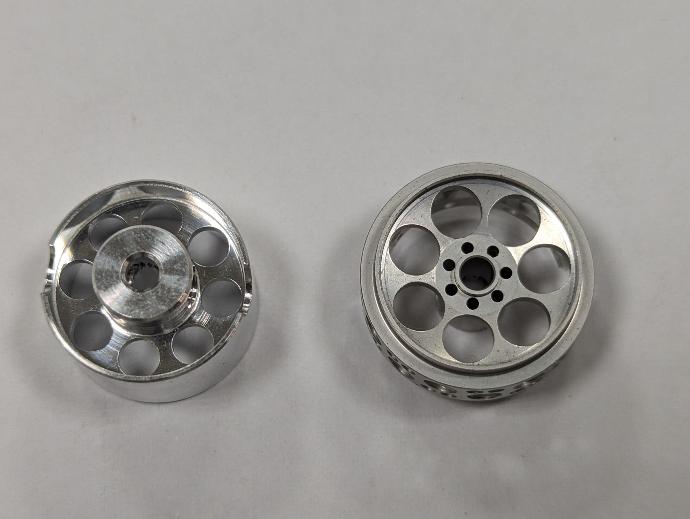
Custom CNC hubs manufactured to spec are compatible with standard slot car scales and platforms, including:
- 1/24 scale racing applications
- 1/32 scale (including Scalextric-compatible and Carrera-compatible geometries)
- Custom or proprietary racing platforms requiring non-standard axle diameters or hub widths
When ordering OEM/ODM, the hub geometry — bore diameter, hub width, flange design, tire retention features — is defined entirely by the buyer's specifications, enabling fitment across virtually any platform.
What to Look for in a CNC OEM/ODM Partner
Not all CNC shops are equally suited to precision hub manufacturing at scale. When evaluating suppliers, consider:
- Machine capability: Swiss-type lathes and multi-axis CNC equipment are prerequisites for consistent sub-0.1 mm tolerances.
- Material expertise: Specific experience with the alloy you're specifying — particularly critical for magnesium.
- Finishing in-house or vetted partners: Surface treatment quality is as important as machining quality for the final product.
- Quality documentation: Inspection reports and material certs should be standard, not an add-on.
- Communication and DFM support: Especially valuable if your designs are still in development.
Suppliers like DMS Group check these boxes by design — they operate Swiss-type and multi-axis CNC lathes, handle surface treatment (anodizing, polishing, protective coatings for magnesium) either in-house or through established finishing partners, and ship batches with full inspection documentation. For buyers doing initial supplier screening, this kind of integrated capability is worth prioritizing over lowest-unit-price quotes.## Final Thoughts
The slot car market — particularly at the performance and collectible end — is increasingly product-differentiated. Brands that invest in custom-specified, precision-manufactured hubs gain tangible advantages: lighter weight, tighter tolerances, distinctive aesthetics, and consistent performance across their product line.
For sourcing managers and product developers considering the OEM/ODM route, the calculus is straightforward. Custom CNC hubs are no longer the exclusive domain of high-budget programs. With accessible prototype pricing, flexible batch sizes, and a well-developed supply base in Taiwan, precision custom hubs are a practical upgrade for brands at any stage of development.
The question isn't whether custom is worth it. It's whether you've found the right manufacturing partner to make it work.