Jul 14, 2026
Overcoming Thermal Bottlenecks: Advanced Aluminum Die-Casting for High-Density Heat Sinks
The rapid evolution of artificial intelligence and high-performance computing has fundamentally transformed hardware architecture. As processing power scales exponentially, managing the immense thermal output is the ultimate barrier determining hardware longevity and performance. High-density heat sinks serve as the primary defense against thermal throttling, yet traditional manufacturing approaches are struggling to keep pace with modern thermal design power requirements. This growing gap between heat generation and heat dissipation highlights a critical industry bottleneck. Advanced aluminum die-casting has emerged as a sophisticated solution, evolving beyond conventional molding to address the microscopic and structural challenges of modern thermal management. By refining the die-casting process, the industry can unlock the unprecedented thermal conductivity and complex geometric freedom required by today's high-power systems.
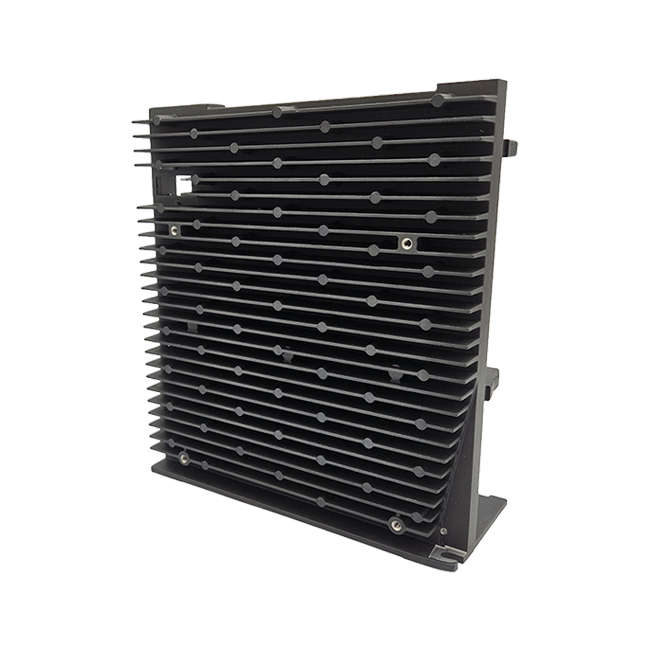
The Core Challenge in High-Density Thermal Management
Component miniaturization combined with elevated power consumption creates localized hot spots that severely threaten system stability. When processors operate at maximum capacity, heat must be transferred away from the silicon die instantaneously. Standard aluminum extrusion or basic die-casting methods often fall short in these extreme environments. Extrusion offers high thermal conductivity but is strictly limited to linear two-dimensional profiles. This restriction makes it impossible to integrate complex mounting structures or direct airflows in multiple directions without expensive secondary operations. Conversely, traditional die-casting allows for complex three-dimensional shapes but frequently suffers from internal microscopic flaws that degrade thermal performance. To overcome these limitations, advanced techniques must be deployed to manipulate the metal's physical properties at a fundamental level.
Advanced Die-Casting Strategies for Maximum Thermal Efficiency
Transforming raw aluminum alloy into a high-performance heat sink requires mastering the metallurgical and fluid dynamics of the die-casting process. Three critical manufacturing hurdles must be overcome to ensure optimal performance.
Minimizing Porosity to Enhance Thermal Pathways
The formation of microscopic air pockets and shrinkage voids within the solidified metal, known as porosity, acts as a severe thermal insulator. When thousands of tiny air bubbles are trapped inside a heat sink, they disrupt the heat transfer path and drastically reduce the overall thermal conductivity of the aluminum component. Advanced manufacturing mitigates this issue through highly optimized gating designs and vacuum-assisted casting technology. By evacuating air from the mold cavity before the molten metal is injected, the formation of gas porosity is virtually eliminated. Furthermore, precisely calculating the injection speed ensures a laminar flow of the molten aluminum, preventing turbulence that typically folds air into the liquid metal. Eliminating these voids maximizes thermal conductivity by creating a solid, uninterrupted thermal pathway while significantly improving the mechanical strength of the final component.
Implementing Precision Mold Temperature Control
The microscopic grain structure of the aluminum directly impacts how efficiently heat travels through the material. This structure is determined entirely by how the molten metal cools and solidifies within the die. Inconsistent cooling rates cause uneven shrinkage, warping, and varying thermal properties across different areas of the heat sink. Implementing precision mold temperature control is essential for producing high-density thermal components. By utilizing advanced thermal fluid circulation systems within the die, temperature gradients are strictly regulated. This ensures that the molten aluminum solidifies at an optimal, uniform rate. Controlled solidification minimizes internal stress, prevents micro-cracking, and produces a dense, uniform grain structure that conducts heat with maximum efficiency. Proper temperature management also extends the lifespan of the tooling itself, ensuring consistent quality over large production runs.
Conquering High Aspect Ratio Fin Geometries
Maximizing heat dissipation requires a heat sink to expose as much surface area to the cooling airflow as possible. This necessitates designing fins that are exceptionally tall, thin, and closely spaced—a geometry known as a high aspect ratio. While highly desirable for thermal management, this design is notoriously difficult to manufacture via die-casting. When molten aluminum is injected into the deep, narrow crevices of a high aspect ratio mold, the metal cools extremely quickly. If it solidifies before reaching the very tip of the fin cavity, it results in a defect known as a "cold shut" or an incomplete fill. Overcoming this requires a delicate balance of high injection pressure, exact metal temperature, and specialized die lubrication. Meticulous preparation ensures that even the thinnest, tallest fins are fully formed without compromising structural integrity.
Evaluating Manufacturing Methods for Thermal Components
Selecting the appropriate manufacturing method involves carefully balancing thermal performance, geometric flexibility, and production scalability. The following table contrasts advanced aluminum die-casting with other common heat sink manufacturing techniques to highlight their respective advantages and limitations.
| Manufacturing Method | Thermal Conductivity | Geometric Complexity | High-Volume Cost Efficiency | Risk of Internal Porosity |
|---|---|---|---|---|
| Traditional Extrusion | Very High | Low (2D profiles only) | High | Very Low |
| CNC Machining | Very High | Extremely High | Low (Slow and expensive) | Very Low |
| Standard Die-Casting | Moderate | High | Very High | High (Without vacuum assist) |
| Advanced Die-Casting | High | High | Very High | Low (Highly controlled) |
While CNC machining and extrusion offer excellent thermal conductivity, they are often restricted by either high production costs or restrictive design capabilities. Advanced aluminum die-casting bridges this gap effectively. By strictly controlling porosity and optimizing thermal dynamics, it delivers the complex three-dimensional geometries required by modern electronics while maintaining the thermal efficiency and cost-effectiveness necessary for large-scale production.
Executing Complex Thermal Designs with Integrated Manufacturing
Transitioning a high-performance heat sink from digital blueprints to physical reality is a complex endeavor. To achieve optimal thermal efficiency, mold design and die-casting parameters must be perfectly matched. When searching for a manufacturing partner, it is highly recommended to select a manufacturer with extensive practical experience in Heat Sink Plates. For example, Gramos Die Casting in Taiwan not only focuses on high-density aluminum die-casting but also provides integrated one-stop services from mold flow analysis to mass production, effectively ensuring the yield rate and performance of thermal components. Advanced manufacturers utilize precise mold flow simulation software prior to production to predict exactly how the metal will behave, allowing them to optimize the draft angles and injection parameters before the first physical prototype is even cast.
Securing the Future of High-Power Hardware
As the demands of artificial intelligence and high-power processing systems continue to push hardware to its absolute limits, thermal management will remain a defining challenge. Overcoming these bottlenecks requires moving beyond legacy manufacturing processes that force a compromise between thermal efficiency and structural complexity. By embracing advanced aluminum die-casting—specifically through rigorous porosity reduction, exacting mold temperature control, and mastering high aspect ratio geometries—the industry can produce heat sinks capable of sustaining the next generation of technological innovation.