Jul 16, 2026
EV Drivetrain Seal Requirements: How They Differ from ICE Vehicle Seal Design
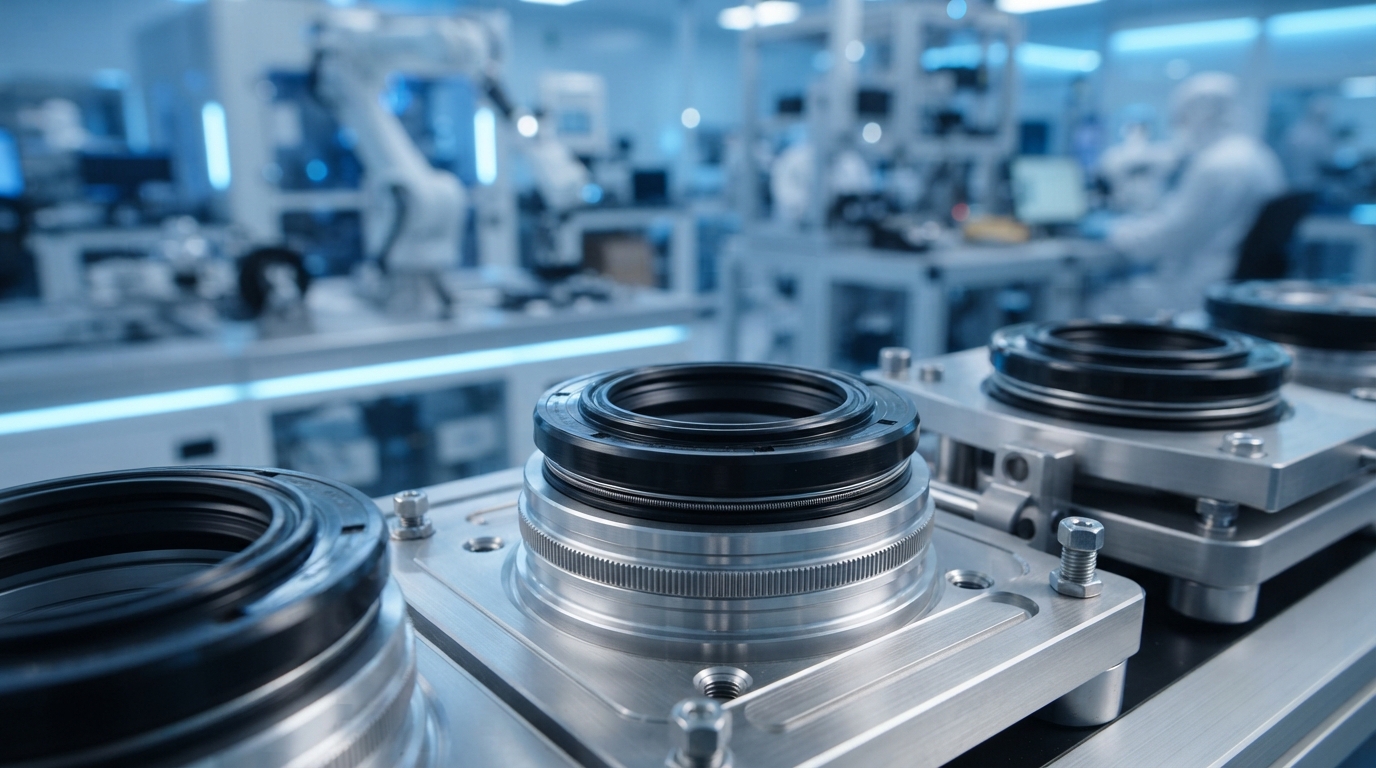
Automakers moving a platform from internal combustion to electric drive quickly discover that sealing is not a simple carryover item. An EV drivetrain seal has to survive conditions that a conventional ICE vehicle seal was never designed for: higher shaft speeds, different lubricant and coolant chemistries, electrical grounding paths, and a thermal profile with almost none of the vibration damping that ICE architectures naturally provide. For automotive OEM and Tier-1 engineering teams, understanding exactly where these requirements diverge is now a sourcing prerequisite, not an afterthought.
Why EV Sealing Can't Simply Reuse ICE Designs
For most of the automotive industry's history, oil seal design followed a fairly stable template. A crankshaft or transmission input shaft turned at a few thousand rpm, engine vibration provided a degree of mechanical damping that helped seal lips maintain contact, and the working fluid was almost always a conventional mineral or synthetic engine oil or ATF with well-understood elastomer compatibility. Seal manufacturers optimized lip geometry, spring-loading, and material selection around that narrow, predictable envelope for decades.
Electrification breaks nearly every one of those assumptions at once. The rise of EV drivetrains, combining a compact electric motor, a single- or multi-speed reduction gearbox, and in many cases an integrated power electronics unit, has compressed several traditionally separate sealing environments into one housing. Engineers who simply substitute a lower-cost general-purpose seal into an e-axle housing, using the same material and lip profile that worked on a legacy transmission, are the ones who see premature leakage, bearing contamination, or insulation failures show up in durability testing. This is the core reason electrification sealing has become its own specialized discipline rather than a subset of conventional oil seal engineering.
The stakes are also higher on EV platforms. A leak on an ICE transmission is a service and warranty issue. A leak that allows dielectric coolant or lubricant to migrate toward high-voltage components, or that lets grounding-critical seal lips degrade, is a functional safety and compliance issue. That difference in consequence is why OEM sourcing teams need a much more specific set of technical questions when they qualify an EV drivetrain seal supplier.
The Core Technical Differences: Speed, Fluid, Electrical, and Thermal
Rotational speed and lip surface velocity
The single biggest mechanical difference between an EV drivetrain seal and a traditional ICE vehicle seal is rotational speed. Because seal lip wear is driven by surface (circumferential) speed rather than rpm alone, this matters enormously: a 30 mm shaft spinning at 30,000 rpm produces a lip surface speed of roughly 47 meters per second, several times what a conventional automotive rotary shaft seal is designed to tolerate.
| Platform | Typical Shaft Speed |
|---|---|
| ICE crankshaft/transmission shaft | Rarely exceeds 6,000 to 7,000 rpm |
| Production electric motor | 18,000 to 20,000 rpm |
| High-speed EV motor designs | Up to 30,000 rpm |
Seal manufacturers responding to this shift have run accelerated life testing at speeds up to around 21,000 rpm on shaft sizes near 38 mm, cycling through temperatures from about minus 40 to over 150 degrees Celsius in oil mist conditions over 500-hour test durations, according to testing protocols reported by seal maker Freudenberg Sealing Technologies. At these velocities, standard lip geometry, spring design, and even the running surface finish of the shaft all need to be re-engineered, and friction has to be minimized because every watt lost to seal drag reduces vehicle range.
Lubricant and coolant chemistry, including dielectric fluids
ICE vehicle seals are formulated against a narrow, well-characterized set of fluids: engine oil, ATF, gear oil, and coolant that never directly contacts rotating shaft seals. EV drivetrains introduce new fluid classes. Some e-axles use low-viscosity, EV-specific gear oils formulated for reduced drag rather than for the additive packages found in legacy ATF. A growing number of designs place the motor windings or battery cells in direct contact with a dielectric fluid for immersion cooling, using base chemistries such as polyalphaolefin, polyol ester, hydrofluoroolefin-based fluids, or silicone oils. Material compatibility research on these fluids shows that common general-purpose elastomers, including EPDM, standard NBR, and some silicones, can swell significantly and lose sealing force when exposed to certain dielectric and immersion cooling fluids, while fluoroelastomers (FKM) and PTFE-based seals tend to hold dimensional stability much better, a pattern documented in elastomer compatibility studies published in journals such as MDPI Applied Sciences. This means a seal material qualified for decades of ICE service, such as a standard NBR compound, cannot simply be assumed compatible with an EV coolant loop without dedicated immersion and swell testing against the specific fluid chemistry in use.
Electrical insulation and grounding
ICE vehicle seals have no electrical function at all. EV drivetrain seals frequently do. Where a seal sits near motor windings, inverter housings, or busbars, it may need to maintain electrical insulation to prevent stray current paths, or conversely, certain conductive or grounding-path components near the seal interface need controlled resistance to bleed off shaft currents safely and prevent electrical discharge machining (EDM) damage to bearings, a known failure mode in electric motors. This introduces a design variable that never existed in conventional sealing: the seal's dielectric properties, and its behavior at the interface with any grounding or shielding hardware, must be specified and verified alongside its mechanical sealing performance.
Thermal management without vibration damping
An ICE engine's own vibration, from combustion pulses and reciprocating mass, tends to help oil seal lips maintain consistent contact pressure against the shaft and disrupts the formation of localized hot spots. Electric motors run smoothly by comparison, with far less inherent vibration, which removes that incidental damping benefit. At the same time, EV drivetrains generate concentrated, localized heat at the motor and inverter under sustained high load, such as towing or repeated fast charging cycles, rather than the more distributed thermal load of an ICE engine bay. Seals near these zones need thermal stability and compression set resistance tuned to sharper, more localized heat cycles, without relying on ambient vibration to keep the lip seated. This changes both material selection and spring or garter-spring design compared to a traditional ICE vehicle seal.
What OEM and Tier-1 Buyers Should Specify
Sourcing teams evaluating rotary shaft seal manufacturers for EV programs should treat the following as baseline specification items rather than optional add-ons:
- Validated shaft surface speed rating, not just an rpm figure, tied to the actual shaft diameter used in the e-axle or motor housing.
- Fluid compatibility data specific to the actual coolant or lubricant chemistry, including swell, hardness change, and compression set results after extended immersion, rather than generic material data sheets.
- Documented low-friction lip design, since drag directly affects vehicle efficiency and range, along with any available friction or torque-loss test data.
- Electrical property specification where relevant, including insulation resistance or intentional conductivity, depending on the seal's position relative to grounding paths.
- Thermal cycling and compression set test data reflecting EV duty cycles (sustained load, fast-charge thermal spikes) rather than ICE-pattern thermal cycles.
- Custom rubber seals capability, because EV housings frequently use non-standard bore and shaft geometries that off-the-shelf catalog seals cannot match, making a supplier's in-house compounding and tooling flexibility a practical requirement, not a convenience.
Buyers should also ask suppliers directly how their qualification testing differs between an ICE-pattern seal and one destined for an e-axle or motor housing. A supplier that answers with the same generic test report for both applications has not actually engineered for the EV-specific environment.
Supplier Solution: Evaluating Lian Yu Oil Seal Against These Criteria
Lian Yu Oil Seal, a Taiwan-based manufacturer with decades of experience in custom-molded oil seals and rubber sealing components for automotive and industrial machinery, offers custom compounding and tooling capability rather than a fixed catalog line.
On the custom rubber seals and non-standard geometry criterion above, buyers with e-axle or motor housings that do not match legacy bore and shaft dimensions should request Lian Yu's tooling lead time and minimum order quantity for a custom seal profile before assuming a catalog part will fit.
On fluid compatibility and qualification testing, buyers should request Lian Yu's material compatibility data for the specific dielectric or EV-specific gear oil chemistry in their design, and ask directly how their qualification test protocol differs between an ICE-pattern seal and an e-axle application, consistent with the specification checklist above.
FAQ
Q: Does an EV drivetrain seal need a completely different material than an ICE vehicle seal? A: Not always, but it often does. The correct material depends on the specific fluid the seal contacts. If the drivetrain uses a conventional low-viscosity gear oil, existing high-performance compounds may still work with revalidated speed and thermal ratings. If the seal contacts a dielectric immersion cooling fluid, material compatibility testing frequently favors fluoroelastomers or PTFE over standard NBR or EPDM, based on the swell and compression set behavior documented in current elastomer compatibility research.
Q: Can existing ICE transmission seals be reused in an e-axle housing to save cost? A: Only after speed, fluid, and thermal requalification. A seal that performed reliably at ICE-typical shaft speeds and fluid chemistries can fail prematurely at e-motor speeds several times higher, or in contact with EV-specific gear oils and coolants it was never tested against. Reuse without full requalification is one of the more common causes of unexpected warranty issues on early EV platform launches.
Q: Who is responsible for specifying seal requirements on an EV program, the OEM or the seal supplier? A: Both, working together. The OEM or Tier-1 owns the operating envelope (shaft speed, fluid chemistry, thermal profile, electrical requirements), while the seal supplier owns translating that envelope into lip geometry, material selection, and validated test data. The clearest EV programs specify these parameters explicitly in the RFQ rather than assuming a supplier will infer them from a legacy ICE part number.
Conclusion
EV drivetrain seal design is not a smaller version of ICE vehicle seal engineering. It is a distinct discipline shaped by higher rotational speeds, new lubricant and dielectric fluid chemistries, electrical insulation and grounding considerations, and a thermal environment that lacks the incidental vibration damping ICE architectures provided for decades. OEM and Tier-1 buyers who specify speed ratings, fluid-specific compatibility data, friction performance, and electrical properties up front, rather than assuming legacy parts carry over, will avoid the durability and safety issues that have already surfaced on early electrified platforms. As electrification sealing matures into its own engineering category, working with manufacturers experienced in both custom rubber seals and high-speed rotary shaft seal design will matter more, not less.
OEM and Tier-1 engineering teams can request Lian Yu Oil Seal's fluid compatibility data and e-axle qualification test protocol for their specific shaft speed and coolant chemistry as a starting point for supplier evaluation.