Aug 25, 2026
The Hidden Engineering Challenges of Heavy-Load E-Cargo Bikes
Why the next generation of cargo bikes must be designed as working vehicles—not simply larger bicycles
Cargo bikes are moving beyond family transportation and lifestyle use. In many cities, they are becoming part of last-mile delivery, service fleets, urban logistics and commercial mobility systems.
The market signal is particularly strong in Europe. According to Germany’s 2025 bicycle industry data, approximately 220,300 cargo bikes were sold during the year, including around 185,300 e-cargo bikes. Overall cargo bike sales remained almost stable, while electric cargo bikes increased slightly.
At the same time, the European Cycling Industries association estimates that cargo bikes could replace vans in 32% of delivery trips and 50% of service trips.
These developments create an important engineering question: how should a cargo bike be designed when it is expected to operate as a working vehicle every day?
The answer involves much more than adding a larger rack or a stronger motor.
1. Payload Is a Dynamic Engineering Problem
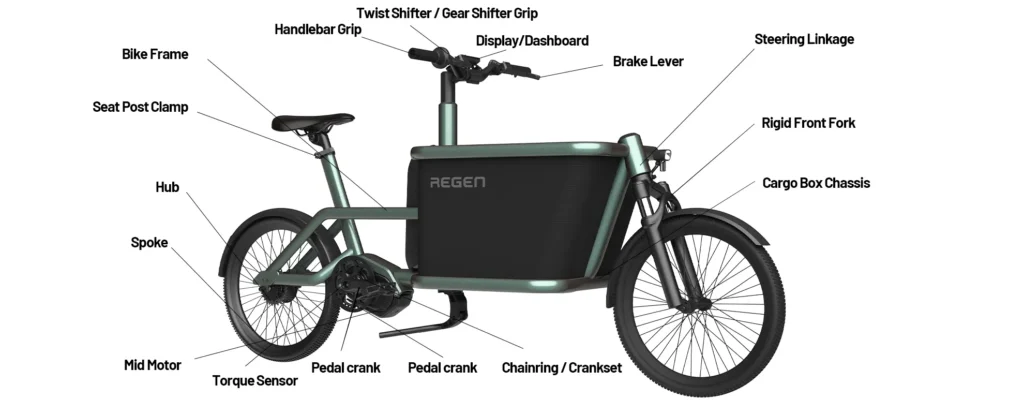
A cargo bike’s advertised payload is only the starting point. Real-world loads move, shift and change throughout a delivery route.
A vehicle carrying boxes, tools, groceries or passengers may experience different load distributions from one trip to the next. Braking, cornering, uneven roads and repeated acceleration can all create forces that are very different from a static load test.
For this reason, component design should consider the complete load path:
- Frame and fork strength
- Wheel and axle interfaces
- Cargo mounting points
- Braking forces
- Steering and handling loads
- Fasteners and connection points
- Repeated fatigue under commercial use
A component that performs well under a single maximum load may still be unsuitable for thousands of repeated delivery cycles. For brands developing commercial e-cargo bikes, the more useful question is not simply “How much weight can it carry?” but “How will the complete system perform under repeated, uneven and changing loads?”
2. Stability and Braking Must Be Designed Together
A heavier cargo bike does not behave like a standard bicycle with additional storage space.
As payload increases, the centre of gravity changes. The effect can be especially noticeable when cargo is positioned high, far from the rider or toward one side of the vehicle. These conditions influence steering effort, cornering behaviour, stopping distance and low-speed control.
Braking performance must therefore be considered together with:
- Wheel size and wheel loading
- Cargo position
- Frame geometry
- Fork and handlebar stiffness
- Brake rotor and caliper selection
- Rider control under both loaded and unloaded conditions
Commercial users also need predictable behaviour when the vehicle is partially loaded. A delivery bike may start its route empty, carry a full load through the city and return with only part of the cargo remaining. The design must remain stable across all of these conditions.
This is one reason cargo bike development increasingly requires a system-level approach rather than isolated component selection.
3. Electrification Multiplies Integration Challenges
Electric assistance adds performance, but it also introduces more interfaces that need to work together.
Depending on the selected drive system, a brand may need to coordinate the motor, battery, crankset, chainring, chainline, frame interface, cable routing and control system. Small differences in mounting dimensions or alignment can create major problems during assembly or servicing.
Compatibility should be addressed before tooling begins. Key questions include:
- Which motor and battery platforms must be supported?
- What chainline and crank interface are required?
- How will cables and hydraulic lines be routed?
- Can technicians access the battery and electrical connections?
- Are replacement parts available for the expected service period?
- Does the design allow future revisions without changing the entire frame?
A component may fit a prototype in a CAD environment but still create problems during mass production, field maintenance or after-sales repair. Early compatibility planning can reduce late-stage redesigns and make the product easier to support in different markets.
4. Durability Means More Than Passing One Test
Commercial cargo bikes are exposed to a demanding combination of conditions:
- Frequent loading and unloading
- Repeated starts and stops
- Uneven roads and kerbs
- Rain, humidity and road contamination
- Long operating hours
- Multiple riders or technicians
- Heavy use of stands, racks and cargo accessories
Durability testing should therefore reflect the intended use case. A family cargo bike and a delivery fleet vehicle may have similar dimensions but very different duty cycles.
A practical testing programme may include material verification, component fatigue, frame and fork testing, braking performance, environmental exposure, corrosion resistance and checks on production-representative samples.
Testing should also be connected to documentation. Brands and importers increasingly need clear information about materials, specifications, test methods, production batches and quality-control procedures.
The cargo bike sector is moving toward greater standardisation in Europe, with industry groups and CEN working on a European framework for cargo bikes.
As the market becomes more professional, suppliers will need to provide not only products, but also evidence that those products are designed and manufactured consistently.
5. Serviceability Is Part of Product Design
For a commercial fleet, downtime is a business cost.
A vehicle that requires a long repair process or a complete replacement when one accessory is damaged may become expensive to operate, even if the original purchase price was competitive.
Serviceability should be considered during product development through:
- Replaceable wear components
- Accessible fasteners
- Standardised interfaces
- Modular cargo accessories
- Clearly defined spare parts
- Repair instructions and technical documentation
- Protection for exposed cables and connections
The development of urban freight micro-hubs, charging stations and shared cargo bike services also shows that cargo bikes are becoming part of wider logistics systems rather than operating as isolated consumer products.
This makes serviceability and lifecycle support increasingly important for manufacturers, fleet operators and importers.
6. Design Requirements Should Begin with the Use Case
Before selecting components, brands should define how the cargo bike will actually be used.
A useful product brief should include:
- Intended application: family, delivery, service, rental or mixed use
- Expected payload and cargo dimensions
- Typical road and weather conditions
- Daily distance and operating hours
- Required motor and battery platform
- Target service life and maintenance model
- Intended sales markets and compliance requirements
- Replacement part and warranty expectations
This information helps suppliers recommend appropriate materials, interfaces, testing methods and production processes.
It also improves communication between the brand, designer, engineer, testing laboratory and manufacturing partner. A clear use case can prevent a common development mistake: optimising one component in isolation while overlooking how the complete vehicle will be used.
7. What Brands Should Ask a Component Partner
When evaluating a cargo bike component supplier, brands should ask more than whether the supplier can provide a catalogue product.
Important questions include:
- Can the supplier support both standard and customised components?
- How are payload, fatigue and environmental requirements translated into testing?
- Can the supplier support different motor and battery interfaces?
- How are design changes controlled between prototype and mass production?
- What quality and traceability documents are available?
- Can the supplier provide replacement parts and technical support?
- Does the supplier understand the requirements of the target sales markets?
The right partner can contribute during the early design stage, when changes are still manageable. This is often more valuable than simply finding a lower unit price after the design has already been completed.
Conclusion
The next generation of e-cargo bikes will not be defined only by higher motor power, larger batteries or greater payload claims. Their success will depend on whether they are reliable, stable, serviceable and properly documented for real-world use.
As cargo bikes enter commercial fleets and urban logistics systems, component decisions will have a direct effect on safety, operating cost, maintenance and brand reputation.
For bicycle brands and importers, the most important engineering decision may therefore be choosing a component partner early enough to contribute to the product—not simply supplying parts after the design is finished.
About the Author
BEV International Corp. is a Taiwan-based bicycle component manufacturer providing OEM and ODM solutions for bicycle brands and importers. The company develops and supplies components and accessories for e-bikes, cargo bikes, folding bikes and other bicycle categories, with capabilities covering product customisation, quality testing, sourcing and consolidated manufacturing.