May 18, 2026
How OEM and ODM Monitor Arm Manufacturers Support Ergonomic Workspace Projects
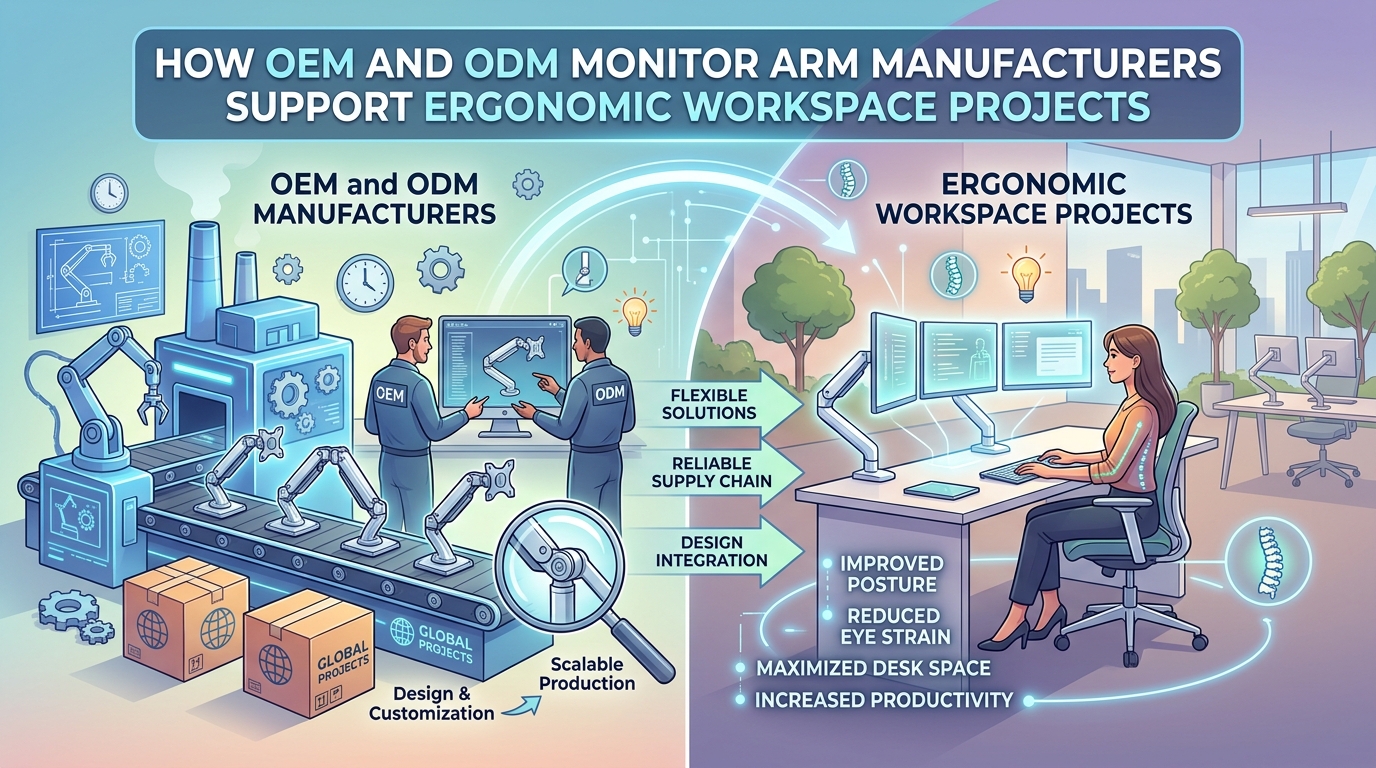
Monitor arms have become an important part of workspace planning across offices, healthcare environments, control rooms, education settings, and technical workstations. Their role extends beyond holding a display in place. In many commercial settings, they support ergonomic adjustment, improve space utilization, and help organizations create work areas that can adapt to different tasks and users.
As demand for flexible workstation equipment grows, buyers often evaluate more than a standard catalog item. They assess whether a manufacturer can provide consistent quality, engineering support, customization options, and reliable export capability. In some procurement environments, trade compliance and country of origin are also relevant considerations.
What a Monitor Arm Manufacturer Provides
A monitor arm manufacturer develops and produces mounting systems designed for one or more displays. These products commonly include single monitor arms, dual monitor arms, multi display mounts, wall mounted systems, and accessories that expand installation flexibility.
The core value of these products usually centers on ergonomic movement, structural reliability, and workspace efficiency. Common features include height adjustment, tilt, swivel, rotation, extension range, clamp mounting, grommet mounting, and cable management. In commercial and institutional purchasing, durable materials such as aluminum and steel are often preferred because they support long service life and stable daily use.
The Role of Ergonomics in Monitor Arm Selection
Ergonomics is one of the main reasons organizations invest in monitor arm solutions. A fixed monitor position may limit posture options and contribute to physical discomfort during extended computer use. Adjustable arms allow screens to be repositioned according to user height, viewing angle, desk layout, and task requirements.
For employers and facilities planners, ergonomic equipment can also support workspace standardization and help create more adaptable environments. In healthcare and technical settings, monitor mobility may improve access to equipment and support more efficient workflow design. As a result, monitor arms are often evaluated as part of a larger workstation strategy rather than as a simple accessory.
OEM and ODM Models in Monitor Arm Manufacturing
OEM and ODM services address different sourcing priorities.
An OEM arrangement is generally suitable for buyers that already have a product concept, technical specification, or brand requirement. The manufacturer produces according to the buyer’s design direction and requested product standards. This may include specific dimensions, structural details, branding elements, surface finish, packaging, or accessory compatibility.
An ODM arrangement is often used when buyers want to introduce or expand a product line with greater speed and lower development complexity. In this model, the manufacturer provides an existing product platform that can be adapted for the buyer’s market. Adjustments may still be made to branding, packaging, selected components, and certain functional details.
In monitor arm projects, OEM and ODM discussions often involve the following factors:
- Display size and weight support
- Mounting method and installation conditions
- Joint performance and movement resistance
- VESA compatibility and accessory integration
- Surface treatment and material requirements
- Branding, packaging, and technical documentation
- Testing, certification, and destination market expectations
A qualified manufacturing partner is generally expected to explain which aspects of a product can be customized, what engineering changes are feasible, and how those changes affect tooling, lead time, and production cost.
Key Criteria for Evaluating a Monitor Arm Supplier
Selecting a monitor arm supplier usually involves both product review and supply chain assessment. A well designed product may not be sufficient if the supplier cannot provide stable production quality, dependable lead times, and clear technical documentation.
Product range and application suitability
A broader product line often allows a manufacturer to support a wider range of project requirements. This may include individual office workstations, dual screen desk setups, multi monitor control environments, and accessory configurations for specialized use.
Engineering and customization capability
Private label and project based sourcing often require more than standard fulfillment. Buyers may request changes in structure, finish, mounting configuration, cable routing, packaging, or branding. Engineering support becomes especially important when the product is intended for integration with furniture systems, medical equipment, or institutional workstations.
Material quality and structural durability
Commercial buyers typically expect stable movement, reliable joints, and durable metal construction. Long term performance matters because monitor arms are frequently repositioned in daily use.
Testing and compliance support
Manufacturers may be asked to provide information related to load testing, durability verification, product safety, and market specific requirements. Complete and accurate documentation can improve purchasing confidence, especially in export or institutional projects.
Production consistency and delivery planning
A supplier should be able to communicate clearly about production scheduling, lead times, packaging methods, and shipment coordination. For repeat orders, consistency from one production batch to the next is often as important as the initial sample approval.
TAA Related Sourcing Considerations
For some buyers, particularly those serving public sector projects or government related contracts, TAA considerations may influence supplier evaluation. In general terms, TAA refers to the Trade Agreements Act framework used in United States federal procurement. A common practical concern is whether a product can be sourced from a compliant country of origin under the relevant procurement rules.
This subject requires careful treatment. TAA status is not a broad marketing label and should not be presented without factual basis. It depends on the product, the manufacturing process, and the origin determination used for procurement purposes. Buyers and suppliers should confirm specific requirements through appropriate legal, trade, or procurement channels before relying on compliance related claims.
What often matters during supplier review is the manufacturer’s ability to provide clear origin information, production transparency, and supporting documentation. Buyers may ask where the product is manufactured, how production is managed, and whether the supplier can support origin review as part of a larger procurement process.
Why Country of Origin Transparency Matters
Global sourcing has become increasingly documentation driven. Buyers are paying closer attention to manufacturing location, supply chain stability, logistics resilience, and compliance support. This affects both supplier selection and internal purchasing approval.
In monitor arm sourcing, origin transparency can help buyers achieve several objectives:
- Stronger visibility into procurement risk
- Better support for institutional purchasing review
- More efficient communication with compliance teams
- Improved confidence in long term supplier relationships
- Clearer alignment with project specific sourcing requirements
Manufacturers that provide clear information about production capability, export experience, and application knowledge are often easier for international buyers to evaluate. This is especially relevant in OEM and ODM projects where the supplier relationship extends beyond product supply into development and long term fulfillment.
Monitor Arm Demand Across Professional Environments
Application requirements vary significantly by sector. Office environments often prioritize ergonomic adjustment, efficient use of desk space, and clean cable organization. Healthcare settings may place greater importance on reliable movement, easy maintenance, and compatibility with clinical workflows. Control rooms and technical workstations often require stability, support for multiple displays, and dependable adjustment over continuous daily use.
Because of these differences, buyers often prefer manufacturers with experience across several professional environments. This can indicate broader engineering knowledge and a stronger ability to recommend configurations that match actual use conditions.
Conclusion
Monitor arms are now widely recognized as functional equipment that contributes to ergonomic performance, workspace efficiency, and operational flexibility. In commercial and institutional purchasing, supplier evaluation often extends beyond product appearance or basic specifications. Buyers typically consider manufacturing capability, OEM and ODM support, documentation quality, and the ability to respond to project specific requirements.
When procurement conditions include TAA related review, the importance of origin clarity and compliance readiness becomes even greater. Manufacturers that combine ergonomic product design, customization support, stable production, and transparent sourcing information are often better positioned to serve distributors, brand owners, and project buyers in international markets.