Jun 29, 2026
How to Choose Between Inch and Metric Brass Tube Fittings
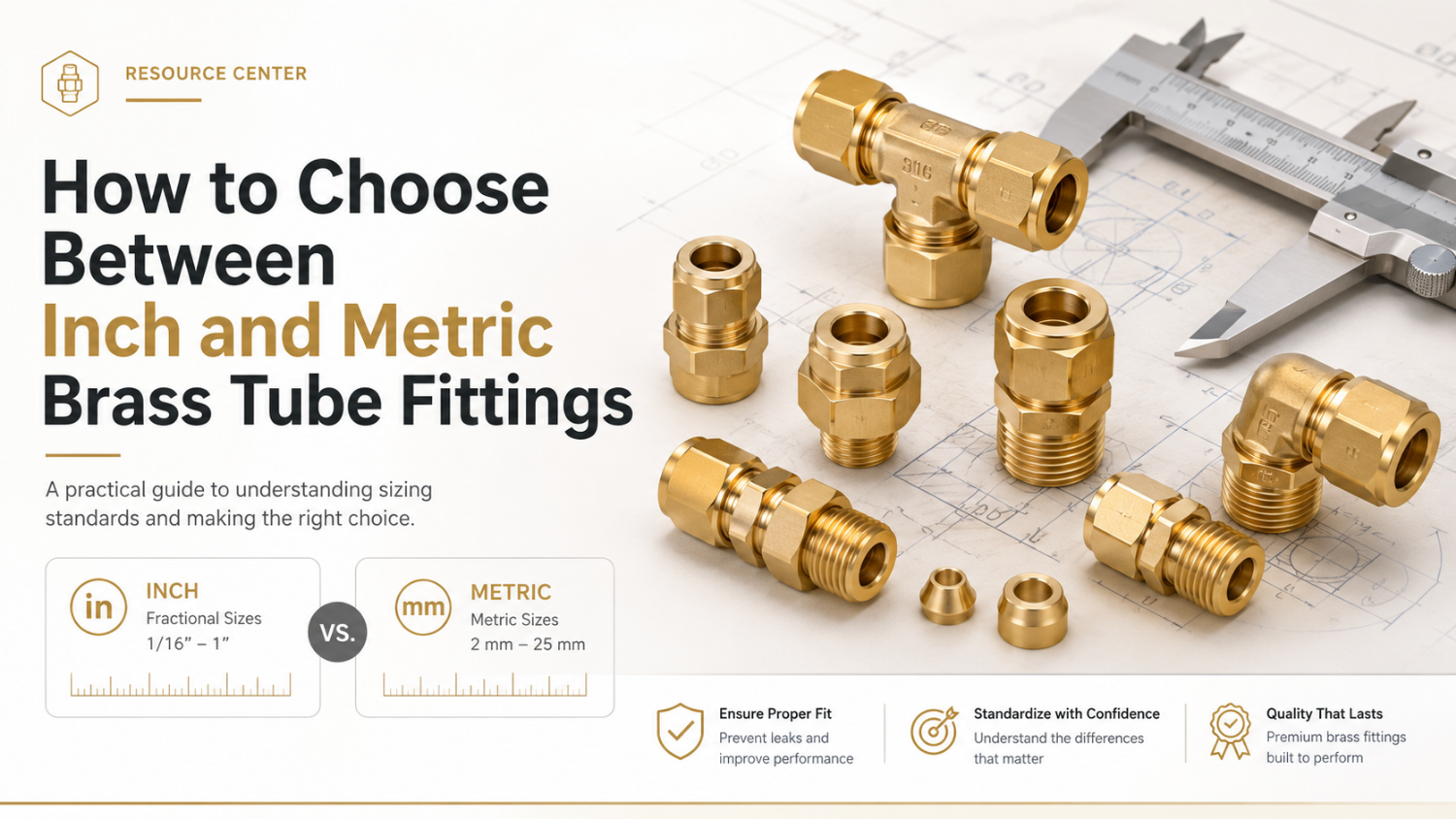
Choosing between inch and metric brass tube fittings is not simply a matter of converting fractions into millimeters. The correct choice depends on the tube’s actual outside diameter, the equipment port, the thread and sealing method, and the standards already used across the system. A fitting that appears close in size may still clamp incorrectly, damage the tube, or fail to seal.
This distinction matters in pneumatic equipment, compressed-air systems, vehicle air lines, fluid-control assemblies, and machinery built for international markets. A machine may use metric tubing but connect to an NPT port. The safest approach is to treat the tube connection and the port connection as separate specifications.
Start With the Tube Outside Diameter
Most small brass tube fittings are selected by the tube’s outside diameter, or OD. Inch tubing is identified with fractional dimensions such as 1/4, 3/8, or 1/2 inch. Metric tubing is identified in millimeters, such as 6, 8, 10, or 12 mm.
These sizes are not interchangeable. For example, 1/4 inch equals 6.35 mm, not 6 mm. Likewise, 3/8 inch equals 9.525 mm rather than 10 mm, and 1/2 inch equals 12.7 mm rather than 12 mm. Fittings depend on controlled contact between the tube and a ferrule, sleeve, collet, or sealing element. An incorrect match can cause poor gripping, tube deformation, or leakage.
| Common inch tube OD | Exact metric equivalent | Nearby metric size | Interchangeable? |
|---|---|---|---|
| 1/4 in | 6.35 mm | 6 mm | No |
| 5/16 in | 7.94 mm | 8 mm | No |
| 3/8 in | 9.53 mm | 10 mm | No |
| 1/2 in | 12.70 mm | 12 mm | No |
| 5/8 in | 15.88 mm | 16 mm | No |
Confirm the OD from the tubing specification, equipment manual, or a calibrated caliper. Do not rely on appearance or rounded conversions.
Separate Tube Size From Thread Size
A common purchasing error is assuming that an “inch fitting” must have an inch pipe thread, or that a metric tube fitting must use an M-thread. In practice, the two ends may follow different systems. A fitting can accept 8 mm tubing and connect to a 1/4-inch NPT port, or accept 1/4-inch tubing and connect to a metric port.
The full description should identify both sides, for example:
8 mm tube OD × G 1/4 male thread
1/4 in tube OD × 1/8 NPT male thread
10 mm tube OD × M12 × 1.5 male thread
This format reduces ambiguity when comparing drawings, samples, and quotations.
Identify the Thread and Sealing Method
Nominal thread size alone is not enough. NPT, BSPT, BSPP, unified threads, and ISO metric threads differ in profile, pitch, diameter, taper, or sealing principle.
NPT is an inch-based pipe thread covered by ASME B1.20.1. BSPT, associated with ISO 7-1, also uses tapered engagement but has a different thread form. BSPP, commonly designated with the letter G and addressed by ISO 228-1, is parallel and normally relies on a sealing surface, washer, bonded seal, or O-ring. ISO metric threads are usually written as a diameter and pitch, such as M12 × 1.5.
Threads that begin to engage are not necessarily compatible. Forcing mismatched threads can damage the port and create an unreliable joint. Verify the designation, male or female form, taper or parallel geometry, pitch, and seal location.
Let the Existing System Guide the Choice
For replacement work, match the installed tube and port exactly. Changing from inch to metric because the converted dimension seems close introduces unnecessary risk.
For new equipment, the choice is more strategic. Metric fittings may suit machinery whose tubing, valves, and maintenance tools are sourced mainly from metric markets. Inch fittings may be more practical for equipment designed around North American tubing, NPT ports, or SAE-based components. Export machinery should reflect the target market and the customer’s service network.
Standardizing one tube-sizing system within a machine also simplifies spare-parts management. Where mixed standards are unavoidable, transition fittings should be documented clearly.
Check More Than Dimensions
Correct dimensions do not automatically make a fitting suitable for service. Brass grade, tube material, wall thickness, fitting design, pressure, temperature, vibration, fluid compatibility, and regulatory requirements all affect selection.
Compression, flare, push-to-connect, and double-ferrule fittings grip and seal differently. A fitting intended for nylon or polyurethane tubing may not suit rigid metal tubing, even when the OD matches. A brass fitting for ordinary compressed air may also lack the rating or approval required for vehicle braking, high-pressure fogging, fuel, potable water, or aggressive media.
Use the manufacturer’s published rating for the complete fitting-and-tube combination. The lowest-rated component should govern the design limit. For safety-critical systems, confirm applicable regulations and approved tubing before substitution.
Build a Clear Purchase Specification
A useful specification should include the fitting style, tube OD and unit system, port thread, sealing method, material or finish, operating medium, maximum pressure and temperature, tube material, and required certification. A drawing or verified sample is valuable when replacing an unmarked component.
Avoid descriptions such as “about 10 mm” or “standard brass connector.” A request such as “90-degree brass male elbow for 10 mm nylon tube, G 1/4 parallel thread, sealing washer required” gives the supplier enough information to check compatibility.
FAQ
Can I use a 6 mm fitting with 1/4-inch tubing?
No. A 1/4-inch tube has a 6.35 mm OD, so a 6 mm fitting is not designed for it.
Are 8 mm and 5/16-inch fittings interchangeable?
No. They are close, but 5/16 inch is approximately 7.94 mm. The difference can affect gripping and sealing.
Does a metric tube fitting always have a metric thread?
No. Tube OD and port thread are separate specifications. Metric tubing may be paired with NPT, BSPP, BSPT, or metric ports through the correct connector.
Can NPT and BSPT fittings be connected?
They should not be treated as interchangeable. Their thread forms differ, and partial engagement does not confirm a reliable pressure connection.
How can I identify an unknown fitting?
Measure the tube OD and thread diameter, determine whether the thread is tapered or parallel, and use a pitch gauge where possible. Compare the results with a reliable guide or supplier drawing.
Which system is better for a new machine?
Neither is universally better. Choose the system that aligns with the machine’s components, destination market, maintenance practices, spare-parts availability, and customer requirements.
Conclusion
The correct choice between inch and metric brass tube fittings begins with exact identification, not conversion. Match the tube OD precisely, specify the port thread independently, confirm how the connection seals, and check the fitting against the application’s pressure, temperature, media, and compliance requirements. Consistent standardization can also reduce assembly errors and long-term maintenance costs.
For projects requiring several fitting styles, tube sizes, or thread combinations, explore the Guang Yang to review brass tube fittings, compression and flare fittings, push-in fittings, adapters, and related connection options. Comparing available configurations with your tubing and port specifications can help narrow the selection before requesting a quotation or custom solution.