Jun 25, 2026
PP Corrugated Board vs. Cardboard vs. Plywood: Choosing the Right Protective Sheet for Construction and Export Packaging
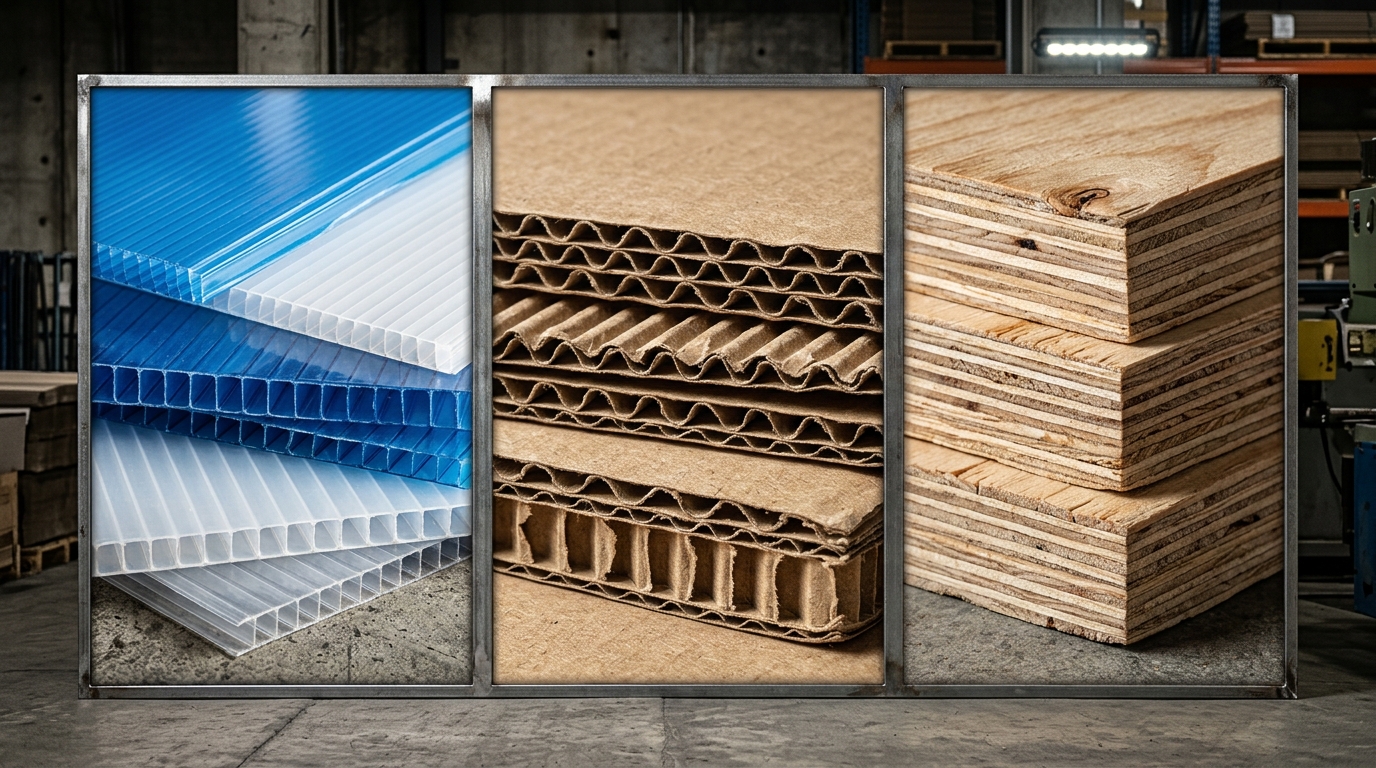
Material selection for construction site protection and industrial export packaging has never been a purely cost-driven decision, but in 2026, the calculation has become significantly more complex. Buyers must now weigh upfront material cost against reusability, moisture resistance, weight implications for freight, and increasingly, recyclability and environmental compliance requirements.
Three materials dominate this category: cardboard (corrugated paperboard), plywood, and polypropylene (PP) corrugated board. Each has a distinct performance profile, and understanding the practical differences is essential for procurement teams, construction project managers, and export packaging engineers who need to make informed sourcing decisions.
Understanding the Three Material Options
Cardboard (Corrugated Paperboard)
Corrugated cardboard is the most widely used temporary protective material globally, primarily due to its extremely low cost and widespread availability. Standard B-flute or C-flute corrugated cardboard is lightweight, easy to cut, and simple to dispose of.
However, its performance limitations are well-documented:
- Moisture sensitivity: Standard cardboard loses structural integrity rapidly when exposed to water, humidity, or concrete moisture — a critical failure mode on construction sites where floor protection is needed during wet trades (tiling, grouting, concrete finishing).
- Limited reuse: Most corrugated cardboard sheets are suitable for single use only. Once compressed, wet, or punctured, they cannot be redeployed effectively.
- Dust and fiber contamination: On high-specification construction projects (hospitality, healthcare, semiconductor fabs), cardboard can generate cellulose fibers and dust that contaminate sensitive surfaces.
- Load-bearing weakness: Under heavy equipment traffic — pallet jacks, lifts, or construction machinery — cardboard compresses quickly and provides inadequate surface protection.
Cardboard's competitive advantage remains its cost: typically USD 0.5–2.0 per sheet for standard sizes, making it viable for very short-duration, single-use applications in dry environments.
Plywood
Plywood has been the traditional choice for heavy-duty construction protection, particularly for protecting finished floors during fit-out phases in commercial construction. Standard 9mm or 12mm plywood can withstand significant point loads and provides excellent rigid surface protection.
Key characteristics:
- Load capacity: Plywood handles concentrated loads from scaffold feet, pallet jacks, and tool trolleys far better than sheet materials.
- Moisture performance: Exterior-grade plywood offers reasonable moisture resistance, but prolonged exposure causes delamination and warping. Interior-grade plywood is highly vulnerable to moisture.
- Weight: 12mm plywood weighs approximately 8–10 kg/m², making installation and handling labor-intensive, particularly in high-rise construction.
- Reusability: Plywood can typically be reused 3–8 times before damage accumulates to the point of replacement.
- Cost: Structural plywood costs approximately USD 8–18 per sheet (1220 × 2440mm), with costs varying by grade and regional timber prices.
The primary limitations of plywood are its weight, the handling labor it demands, and its susceptibility to moisture damage when improperly stored. On projects with tight delivery access (urban fit-out, occupied building refurbishment), the bulk and weight of plywood create logistical challenges that drive up total project cost.
PP Corrugated Board
Polypropylene corrugated board — also known as PP hollow board, twinwall PP sheet, or fluted PP board — represents the engineered alternative that addresses the key weaknesses of both cardboard and plywood in temporary protection applications.
PP corrugated board is manufactured from polypropylene resin in a twin-wall extrusion process, creating a lightweight rigid panel with hollow internal channels. Standard grades range from 2mm to 10mm thickness, with varying flute configurations depending on the required stiffness-to-weight ratio.
Performance advantages:
- Moisture and chemical resistance: PP is inherently hydrophobic. PP corrugated sheets maintain their structural integrity even after prolonged contact with water, cement, mortar, adhesives, and cleaning chemicals — a critical advantage on construction sites.
- Lightweight: A standard 4mm PP corrugated sheet weighs approximately 400–700g/m², compared to 8,000–10,000g/m² for 12mm plywood. This dramatically reduces handling labor and makes single-person installation practical.
- Reusability: PP corrugated sheets can typically be reused 5–20 times depending on thickness and application, significantly reducing cost-per-use compared to both cardboard and plywood.
- Surface cleanliness: PP sheets do not generate fibers, dust, or moisture — making them appropriate for cleanroom construction, hospital refurbishments, semiconductor facility fit-out, and luxury hospitality projects.
- Customization: PP corrugated board can be produced in custom colors, printed with safety warnings or project identifiers, and die-cut to any shape.
Cost-Per-Use Analysis: The Real Procurement Metric
A common procurement mistake is comparing materials on unit price alone. The relevant metric for temporary protection materials is cost-per-use, which accounts for reusability over the protection phase of a project.
| Material | Unit Cost (USD, 1000 × 2000mm) | Typical Uses per Sheet | Cost Per Use |
|---|---|---|---|
| Single-wall cardboard | USD 1.50 | 1 | USD 1.50 |
| Plywood 9mm | USD 10–15 | 5–8 | USD 1.50–3.00 |
| PP corrugated board 4mm | USD 3–6 | 8–15 | USD 0.25–0.75 |
| PP corrugated board 6mm | USD 6–10 | 12–20 | USD 0.35–0.80 |
When total project protection costs are calculated across multiple reuse cycles, PP corrugated board frequently delivers the lowest cost-per-use of the three options, particularly on medium to long-duration projects where material can be redeployed across floors or project phases.
Export Packaging: PP Corrugated Board's Growing Role
Beyond construction site protection, PP corrugated board has established a growing presence in export packaging applications. Taiwan's manufacturing sector — which exports precision machinery, electronics, automotive components, and industrial equipment — has been an early adopter of PP corrugated dividers, edge protection inserts, and reusable pallet liner sheets.
Key applications in export packaging include:
- Interleaving sheets: PP sheets placed between stacked metal components or glass panels prevent surface scratching and abrasion damage during transit.
- Divider systems: Custom-die-cut PP corrugated dividers create cell-type inserts within export cartons, replacing foam and pulp inserts for lighter-weight, reusable alternatives.
- Pallet cap and liner sheets: PP sheets on pallet tops and bases provide moisture resistance and load distribution that cardboard cannot maintain in humid shipping container environments.
- Returnable packaging systems: Unlike single-use cardboard, PP corrugated components can be returned and reused within closed-loop supply chains, reducing both waste and ongoing material cost.
Japan's logistics sector has particularly embraced Taiwan-made PP corrugated sheets for returnable packaging applications — recognizing the material's combination of lightweight, durability, and recyclability as aligned with Japan's strict waste reduction targets.
Environmental and Sustainability Considerations
For construction firms and manufacturers with sustainability reporting obligations, PP corrugated board offers several advantages over cardboard in terms of lifecycle environmental impact:
- PP is fully recyclable through standard polyolefin recycling streams. End-of-life sheets can be granulated and reprocessed into new PP products.
- Multi-use reduces material throughput: A PP sheet used 15 times replaces 15 cardboard sheets, with corresponding reductions in raw material consumption, packaging waste, and disposal costs.
- No hazardous decomposition products: Unlike treated or wax-coated cardboards, standard PP does not produce hazardous leachate when disposed.
It should be noted that cardboard from sustainably managed sources carries its own environmental credentials, and for very short-duration single-use applications, cardboard's renewable fiber origin may be preferable. The most appropriate choice depends on application duration, reuse potential, and local recycling infrastructure.
FAQ
Q: Can PP corrugated sheets protect high-gloss or polished surfaces from scratching? A: Standard PP corrugated sheets provide good abrasion resistance but may cause minor surface marking on extremely sensitive surfaces such as mirror-polished marble or high-gloss lacquered panels if dragged across the surface. For the most sensitive applications, self-adhesive PE foam-backed PP sheets are available, providing a non-scratch interface. It is always recommended to test on a sample of the finish before full deployment. For most construction-grade finishes including polished concrete, large-format tile, and engineered stone, standard PP corrugated sheets provide effective protection.
Q: What thicknesses of PP corrugated board are suitable for heavy equipment? A: For pedestrian traffic and light tool trolleys, 3–4mm PP corrugated sheets provide adequate protection for most floor finishes. For light machinery (up to 200kg/m²), 5–6mm sheets are recommended. For heavier point loads — scaffold towers, scissor lifts, or pallet jacks with loads above 500kg — 8–10mm thick PP corrugated board or rigid PP foam composite sheets should be specified, and sheets should be overlapped to prevent movement. For very heavy equipment such as air handling units being craned over finished floors, plywood combined with PP sheets may provide the optimal solution.
Q: Is PP corrugated board suitable for outdoor use? A: PP has good UV resistance and weather resistance compared to cardboard, but prolonged direct UV exposure (several months of outdoor use) will gradually degrade the material and reduce its structural properties. For outdoor applications, UV-stabilized PP grades should be specified. For most construction site uses — which are typically temporary and covered — standard PP corrugated board performs well.
Conclusion
The choice between PP corrugated board, cardboard, and plywood for construction site protection and export packaging ultimately depends on the specific application requirements, project duration, and total-cost-of-ownership analysis rather than unit price comparison alone. For medium-to-long-duration construction projects, environments where moisture resistance is critical, or export packaging systems where returns are practical, PP corrugated board typically delivers the best combination of performance, cost-per-use, and sustainability profile.
Polariod Enterprise Co., Ltd., a Taiwan-based specialist in PP corrugated board and PP hollow profile sheets, offers a range of products specifically engineered for construction protection, logistics, and export packaging applications. With manufacturing flexibility from 2mm to 10mm thickness and the capability to supply custom colors, print, and die-cut formats, Polariod works with construction contractors, packaging engineers, and industrial buyers across Asia and beyond to match the right material specification to each application.