May 18, 2026
Compatible Toner Cartridges: Quality, Yield, and Key Buying Considerations
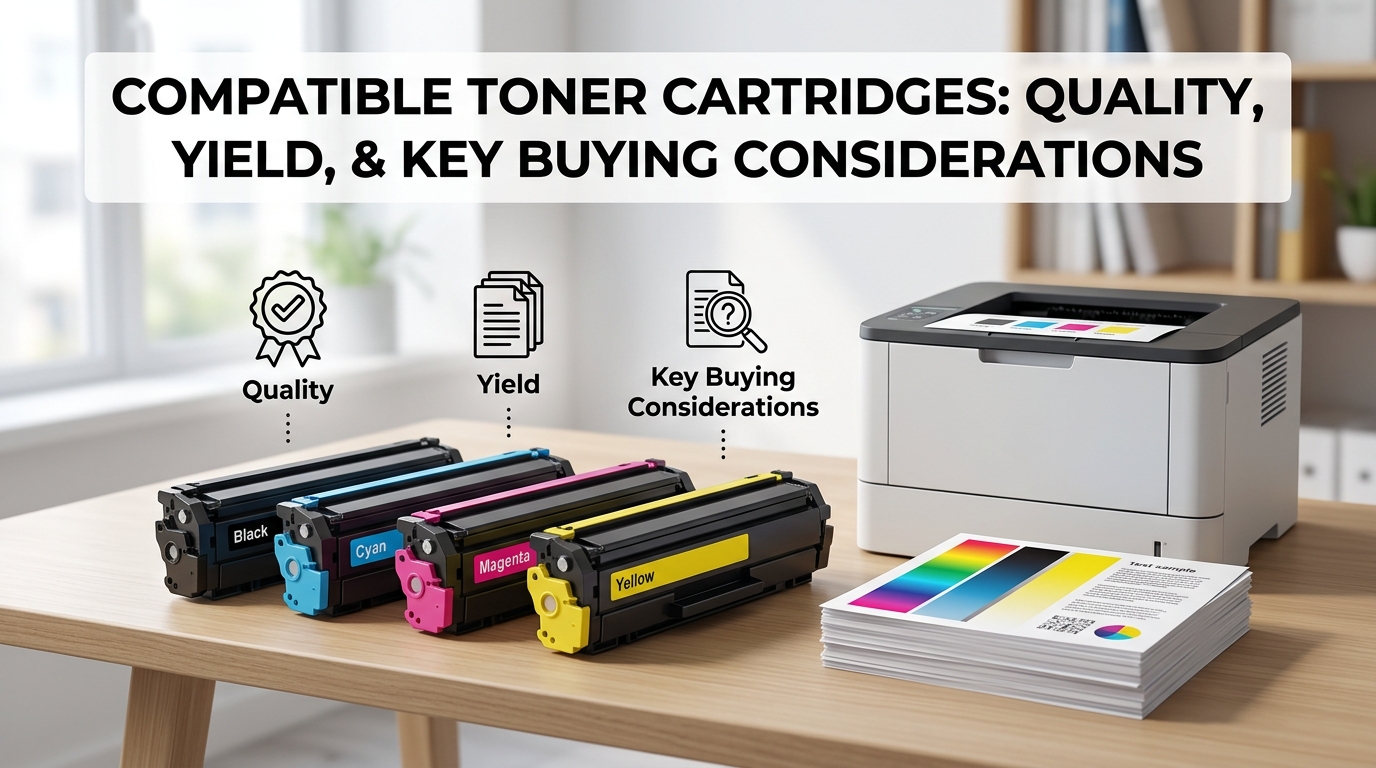
Compatible toner cartridges are third party products designed for specific laser printer models. They are widely used because they offer a lower purchase price than original brand cartridges, but cost is only one part of the decision. Print quality, page yield, chip performance, fit, and batch consistency all affect how a cartridge performs in actual use.
For buyers, distributors, and private label suppliers, compatible toner cartridges are best viewed as a quality dependent category. A well made product can offer stable output and competitive value. A poorly made one can lead to print defects, recognition errors, leakage, and unnecessary replacement cost.
What Compatible Toner Cartridges Are
A compatible toner cartridge is a newly manufactured cartridge made by a third party for use with a specific printer model. It is different from a remanufactured cartridge, which starts as a used cartridge that is cleaned, rebuilt, refilled, and returned to the market.
This distinction matters because the two categories are produced in different ways. Compatible cartridges rely on new components and fresh production. Remanufactured cartridges depend on the condition of the recovered shell, the rebuilding process, and the quality of replacement parts.
Why Buyers Choose Compatible Toner Cartridges
The main reason is cost. Many businesses want to lower printing expenses without changing their existing printer fleet. Dealers and distributors may also look for products that allow broader sourcing options, stronger margin control, or private label opportunities.
At the same time, price alone does not determine value. The market for compatible toner cartridges has become more segmented. Some products are made with tighter process control, better chip stability, and more consistent toner formulation than others. As a result, supplier selection has a direct effect on product performance.
Compatible Cartridges and Original Brand Cartridges
Original brand cartridges are generally associated with stronger consistency, stable device communication, and more predictable output. Compatible cartridges are designed to work with the same printer models, but their performance depends more heavily on engineering accuracy and manufacturing control.
The main differences usually appear in print stability, page yield, chip recognition, and physical fit. When those areas are well managed, compatible cartridges can work well in many applications. When they are not, users are more likely to see streaking, light print, error messages, or fit related issues.
Compatible vs Remanufactured Toner Cartridges
Compatible and remanufactured toner cartridges are often grouped together, but they are not the same product type. A compatible cartridge is newly built. A remanufactured cartridge uses a previously used shell that has been processed for reuse.
That difference affects quality control. Compatible cartridges depend on the accuracy of new production. Remanufactured cartridges depend on inspection, cleaning, replacement of worn parts, and the remaining condition of the reused body. Both can vary in quality, but the source of that variation is different.
For suppliers, this distinction should be clear in product naming, specifications, and technical documents. Clear classification helps reduce confusion in the market and supports more accurate buyer expectations.
What Affects Print Quality
Print quality depends on more than toner fill. Toner formulation, particle behavior, charge control, sealing quality, chip communication, and mechanical fit all influence the final result.
When these factors are not controlled well, the most common problems include weak density, streaks, background haze, smearing, uneven output, and toner leakage. These issues are not simply a feature of compatible cartridges. In most cases, they point to inconsistent manufacturing or poor component matching.
A stronger product is usually defined by stable toner performance, accurate cartridge fit, clear model matching, and repeatable inspection standards. In practice, those details matter more than broad claims about compatibility.
Page Yield and Cost per Page
Page yield is one of the most important buying factors. A cartridge with a lower purchase price may not offer better value if it prints fewer pages or needs to be replaced more often. That is why experienced buyers focus on cost per page, not only unit cost.
Yield claims should also be reviewed carefully. Suppliers that reference recognized testing standards offer a more credible basis for comparison. Even so, actual output can vary depending on print coverage, document type, printer condition, and user settings.
For distributors and private label programs, yield consistency matters as much as stated yield. Unstable output creates returns, weakens buyer confidence, and damages long term product credibility.
Firmware, Chips, and Recognition Issues
Recognition problems remain one of the most practical concerns in this category. Many printers use chips to identify supplies, track usage, and communicate cartridge status. When firmware changes occur, a cartridge that previously worked may trigger an error message or fail to be recognized.
This is one of the main reasons compatible toner cartridges are sometimes seen as risky. In many cases, the issue comes down to chip design, firmware response, and supplier support. Products backed by stronger technical support and better update handling are generally easier to manage than products sold only on price.
For manufacturers and supply partners, chip stability is not a minor feature. It is part of the overall product experience and has a direct effect on customer satisfaction.
Warranty and Risk Considerations
Warranty concerns often influence buying decisions, especially for new users of compatible supplies. In practice, the key issue is whether a product causes a specific problem, not simply whether it is a third party cartridge.
This is why documentation, traceability, and after sales support matter. Buyers that test new supply sources carefully and respond quickly to leakage or recognition issues are in a much better position than buyers who select purely on price.
A realistic risk assessment should include product consistency, supplier accountability, return handling, and the availability of technical support.
What Buyers Should Review Before Sourcing
Before choosing a compatible toner cartridge supplier, buyers usually review several practical points:
- Exact printer and cartridge model compatibility
- Yield claims supported by recognized test standards
- Clear product specifications and accurate labeling
- Stable print quality across batches
- Chip performance and firmware response support
- Return policy and after sales service
- Production control and traceability
These points matter for retail channels, distribution programs, and private label supply. The goal is not simply to find a lower quote. It is to identify a supplier that can deliver stable quality over time.
Why Manufacturing Capability Still Matters
Compatible toner cartridges are closely tied to manufacturing capability. Cartridge fit, toner formulation, electronics integration, sealing control, and inspection standards all influence field performance. Because of this, supplier quality cannot be judged by price alone.
Manufacturers with better process control, clearer specifications, and stronger technical support are in a better position to support long term business. This is especially important for private label programs and contract supply relationships, where product consistency affects brand reputation as much as product cost.
Closing View
Compatible toner cartridges remain an important option for buyers looking to reduce printing costs, but they are not a uniform category. Product quality can vary significantly from one supplier to another.
The most practical way to evaluate them is to look beyond headline pricing and focus on print consistency, yield reliability, chip stability, fit, and supplier support. In this market, repeatable quality is what separates a usable alternative from a recurring problem.