Jun 29, 2026
How Tariff Volatility Is Changing OEM/ODM Sourcing Decisions in 2026
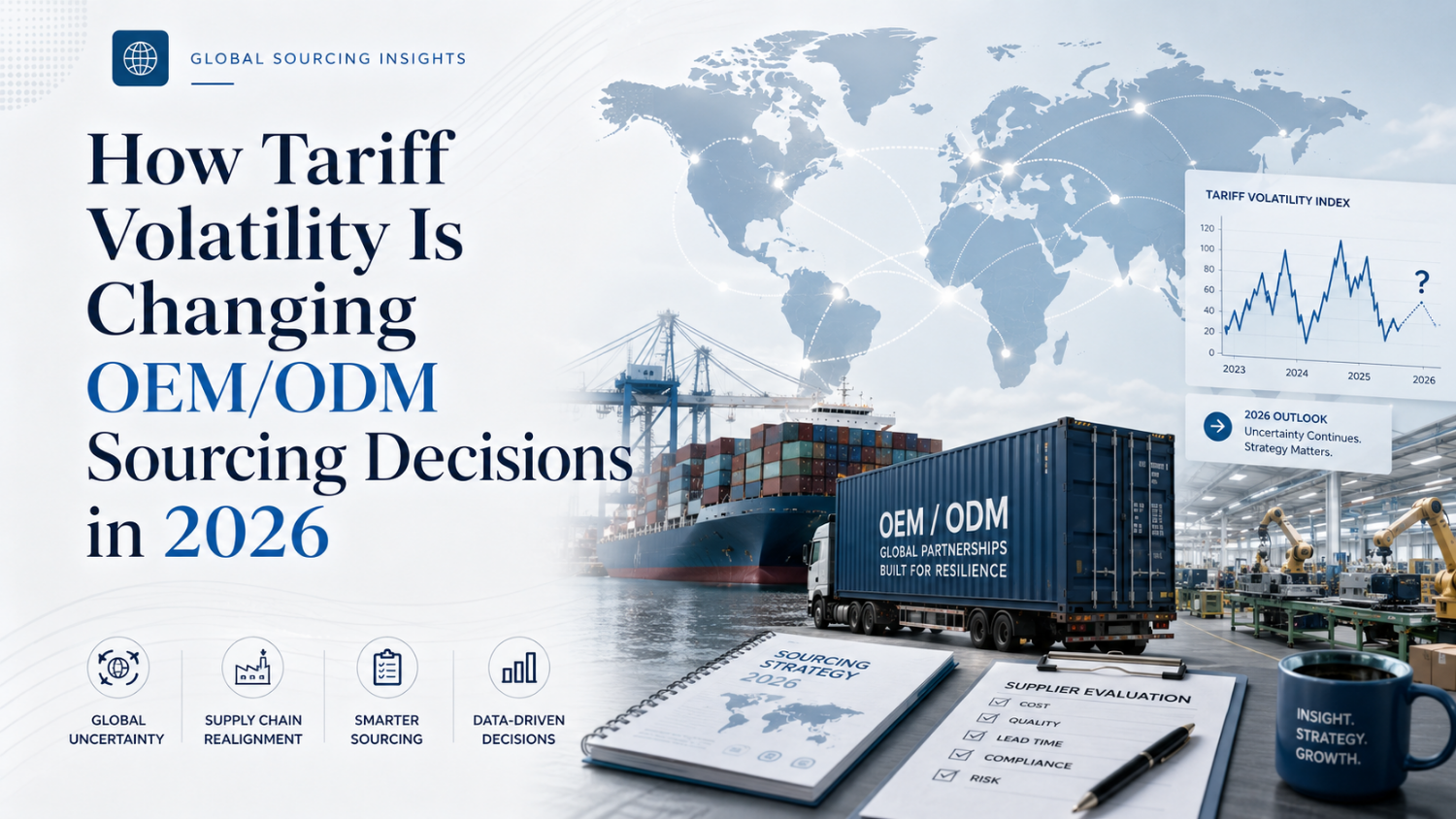
Tariffs have always influenced international sourcing, but in 2026 the challenge is no longer simply whether a duty exists. Buyers must also consider how quickly it can change, which legal authority supports it, whether exclusions apply, and how origin is determined for a multi-country bill of materials.
The United States illustrates this uncertainty. In February 2026, the U.S. Supreme Court held that the International Emergency Economic Powers Act did not authorize the tariffs challenged before it. The administration then introduced a temporary 10% surcharge on covered imports under a different provision of the Trade Act. Sector-specific measures and country arrangements still produce different outcomes by product and origin.
For OEM and ODM buyers, the goal is therefore no longer to find only the factory with the lowest quoted price. It is to build a supply arrangement that remains commercially workable when duty rates, documentation requirements, or trade routes change.
Static Landed-Cost Models Are No Longer Enough
A traditional sourcing comparison combines factory price, tooling, freight, insurance, customs duty, and inland delivery into one landed-cost figure. That figure becomes unreliable when the duty assumption can change before mass production or customs entry.
Procurement teams are increasingly using scenarios rather than one forecast. A practical model may compare the current tariff, a moderate increase, a product-specific surcharge, and an exemption or preferential-rate case. It should also show who absorbs each change: the buyer, manufacturer, distributor, or customer.
A tariff increase does not automatically make an existing supplier uncompetitive. Exchange rates, freight, and production efficiency may offset part of the change. The key shift is that sourcing approval now requires sensitivity analysis, not only a price comparison.
Country of Origin Has Become a Design Variable
A factory’s address does not necessarily establish the customs origin of the finished product. Origin may depend on where substantial transformation occurs, while trade agreements may apply more detailed product-specific rules.
This matters when an OEM or ODM project combines components, subassemblies, firmware, and final assembly from several economies. Moving packaging or simple assembly to another country may not change origin. A more meaningful manufacturing process, different component sourcing, or redesigned architecture may be required.
Buyers are therefore asking for a traceable bill of materials, processing locations, tariff classifications, and evidence supporting origin claims before sample approval. Customs review is moving earlier in development, when changes remain feasible.
Diversification Is Replacing Automatic Reshoring
Tariff exposure has encouraged nearshoring and regional manufacturing, but moving all production home is not automatically the safest response. OECD modelling found that broad relocalization could reduce global trade by more than 18% and global real GDP by over 5%, without consistently improving resilience.
For many programs, qualified diversification is more practical. A buyer may retain a strong supplier while developing a second route in another region suited to the destination market. The objective is not full duplication, but credible alternatives for critical products, components, or final assembly.
| Sourcing issue | Traditional approach | 2026 approach |
|---|---|---|
| Supplier selection | Lowest acceptable unit cost | Risk-adjusted landed cost |
| Manufacturing footprint | One optimized factory | Primary source plus qualified alternatives |
| Product design | Function and cost focus | Component and origin flexibility |
| Contracting | Fixed price | Tariff triggers and review clauses |
| Compliance | Checked near shipment | Reviewed during quotation and development |
OEM and ODM Models Are Being Evaluated Differently
In an OEM project, the buyer usually controls more specifications and bill-of-material decisions. That can make origin analysis and substitutions more transparent, although the buyer may carry more engineering work when redesign is needed.
An ODM supplier may offer quicker access to an existing platform and take greater responsibility for modifications. However, buyers need visibility into component origins, alternative parts, tooling ownership, and certification limits. A low-cost platform is less attractive if replacing one tariff-exposed component requires full recertification or locks production into one country.
The preferred supplier is increasingly the one that can explain how its product and manufacturing route can be reconfigured, not merely the one with available capacity.
Contracts and Inventory Policies Are Becoming More Flexible
Long-term agreements need clear treatment of new tariffs, exclusions, and customs reclassification. Clauses may define the baseline duty, required evidence, allocation of changes, and renegotiation thresholds.
Inventory planning is also changing. The World Trade Organization reported that frontloading and inventory management shaped trade flows ahead of expected tariff changes in 2025. Importing early can protect a launch from a known effective date, but repeated frontloading ties up cash, increases storage costs, and risks obsolete stock.
Selective buffering is usually safer. Long-lead components, regulated products, and stable-demand items may justify additional inventory, while highly customized or fast-changing goods require more caution.
Compliance Capability Is Part of Supplier Performance
Tariff volatility overlaps with broader border-data requirements. The EU Carbon Border Adjustment Mechanism entered its definitive phase in 2026, adding emissions-related obligations for covered goods. Although CBAM is not a conventional tariff, it shows why material, origin, and production data increasingly affect market access and import cost.
Supplier audits should therefore assess classification discipline, origin records, component traceability, relevant emissions data, and the ability to support customs inquiries. Weak documentation can erase the savings promised by a lower quotation.
FAQ
1. Should buyers leave a country as soon as tariffs rise?
Not necessarily. Compare the duty with tooling, qualification time, logistics, quality risk, and the likely duration of the measure. Immediate relocation can cost more than the tariff.
2. Is dual sourcing always necessary?
No. It is most valuable for high-revenue products, constrained components, long tooling cycles, or markets with materially different tariff exposure.
3. Can final assembly in another country change origin?
Sometimes, but simple assembly, repacking, or labeling may be insufficient. The applicable rules and degree of transformation must be reviewed for the product.
4. What tariff information belongs in an RFQ?
Request the proposed classification, manufacturing country, component origins, processing steps, Incoterm, declared-value basis, and assumptions behind the landed-cost estimate.
5. How should tariff costs be divided?
There is no universal formula. Contracts should define the baseline rate, proof required, sharing method, notice period, and treatment of later refunds or exclusions.
6. Does ODM sourcing reduce tariff risk?
It may improve redesign speed, but it can also reduce transparency. The outcome depends on bill-of-material visibility, substitution options, tooling rights, and certification requirements.
Conclusion
Tariff volatility is not ending global OEM/ODM sourcing, but it is changing how decisions are made. Strong programs in 2026 combine competitive manufacturing with origin visibility, scenario-based landed-cost analysis, flexible contracts, selective diversification, and designs that accommodate alternative components or production routes.
Resilience does not mean moving everything to one supposedly safe location. It means knowing where tariff exposure enters the product, deciding which risks deserve a second option, and preserving the ability to respond without rebuilding the entire supply chain.
References
-
Supreme Court of the United States. Learning Resources, Inc. v. Trump, No. 24-1287, February 20, 2026.
-
The White House. Imposing a Temporary Import Surcharge to Address Fundamental International Payments Problems.
-
Office of the United States Trade Representative. Presidential Tariff Actions.
-
Organisation for Economic Co-operation and Development. OECD Supply Chain Resilience Review.
-
World Trade Organization. Global Trade Outlook and Statistics, March 2026.
-
U.S. Customs and Border Protection. Marking of Country of Origin on U.S. Imports.
-
European Commission, Taxation and Customs Union. Carbon Border Adjustment Mechanism.